


In a joint report released on Tuesday, they said the freeze could remain in place until an Armenian referendum on EU membership demanded by Moscow.
Russian President Vladimir Putin first demanded such a vote following two European summits held in Yerevan in early May. The presidents of Belarus, Kazakhstan and Kyrgyzstan backed the demand in a joint statement with Putin adopted at an EEU summit in late May boycotted by Pashinian. They instructed their prime ministers to present a report on “possible consequences” of Armenia’s membership suspension before their next summit planned for December.
The resulting report posted on the Russian government’s website says that Russia, Belarus, Kazakhstan and Kyrgyzstan “have the right to consider” the suspension because of a 2025 Armenian law that declares the start of a “process” of the South Caucasus nation’s accession to the EU. The law runs counter to the EEU’s founding treaty and other rules, it says.
“If the Republic of Armenia diligently fulfills its EEU obligations, it will be unable to meet the obligations associated with accession to the EU,” reads the report. “Conversely, fulfilling the obligations undertaken for the purpose of joining the EU would entail a violation of its EEU commitments.”
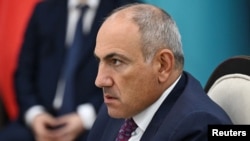
Prime Minister Nikol Pashinian’s government or political allies did not immediately react to the report. Pashinian has repeatedly rejected the Russian demands for the referendum followed by a Russian ban on imports of Armenian agricultural products. Russian officials have warned of further sanctions against Yerevan, notably a sharp rise in the price of Russian natural gas supplied to Armenia.
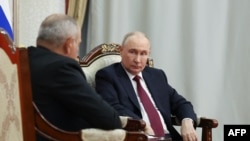
Putin and Pashinian publicly sparred on the referendum issue during their September 1 talks held in Kyrgyzstan. The two leaders are expected to meet again before the EEU’s December summit in Saint Petersburg.
While ruling out any reversal of his pro-Western foreign policy, Pashinian appears to have sought to placate Moscow in recent weeks, mindful of his country’s heavy economic dependence on Russia. He confirmed last week that he is no longer demanding an end to Russia’s long-term management of Armenia’s railway network. Earlier this month, the Armenian premier signaled readiness to accept a Russian proposal to build a new nuclear plant in Armenia.
Russia is Armenia’s number one trading partner. According to Armenian government data, it accounted for 28 percent of Armenian foreign trade in the first five months of this year, compared with the EU’s 16.7 percent share. Russia also supplies the bulk of natural gas used in Armenia at a significant discount.
The report released on behalf of the Russian, Belarusian, Kazakh and Kyrgys premiers warns that the EEU membership suspension would end that price discount and result in a sharp fall in Armenian exports to Russia. Armenia’s GDP would shrink by 15.6 percent as a result, it says.