


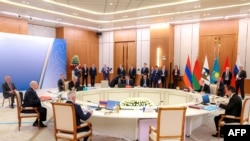
Russian President Vladimir Putin and his Belarusian, Kazakh and Kyrgyz counterparts voiced the demand during an EEU summit in Kazakhstan’s capital Astana shunned by Prime Minister Armenian Prime Minister Nikol Pashinian.
“We share the [Russian] position on the need to hold a national referendum in the Republic of Armenia as soon as possible on joining the European Union or continuing to be part of the Eurasian Economic Union,” they said in a joint statement publicized right after the summit.
The statement came ten days before Armenia’s parliamentary election in which the ruling Civil Contract party is challenged by opposition groups promising to repair Russian-Armenian relations.
Putin already suggested such a referendum on May 9 a few days after the Armenian government hosted two European summits that underlined its pursuit of Armenia’s eventual accession to the EU. Pashinian essentially rejected the idea. Moscow has since banned the import of some Armenian products and threatened to end a significant discount on the price of natural gas supplied to the South Caucasus country.
On Thursday, Pashinian dismissed Putin’s earlier statement that Yerevan’s continued membership in the EEU is “not compatible” with its European integration drive.
“It could be compatible until 2030, until 2035, until 2040 or December 2026,” he told reporters. “Time will tell. It is our sovereign decision, and we will make our sovereign decisions.”
“Nothing has changed in our plan,” added the Armenian premier, who is facing a tough reelection battle.
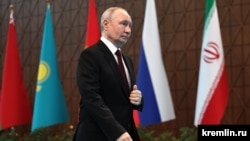
The joint statement by Putin and the three other EEU leaders said that this policy carries “significant risks to the economic security” of their nations. It said their prime ministers will present in December “possible consequences” of suspending Armenia’s membership in the bloc.
Pashinian has stressed in recent weeks that Armenia cannot be kicked out of the EEU without its consent. His domestic critics say that even if Pashinian vetoes its exit, Moscow will still be in a position to impose crippling economic sanctions on Yerevan. Armenia is heavily dependent on Russia for trade and energy, a fact regularly emphasized by Putin and other Russian officials.
Putin made the same point when he spoke to reporters in Astana after the summit. He warned of other punitive measures against Armenia such as higher freight shipment costs, curbs on Russian tourists visiting the country and tougher requirements for hundreds of thousands of Armenian migrant workers in Russia. And he again noted that Russia’s conflict with Ukraine broke out after Kyiv’s decision to strive for EU membership.
Pashinian’s government enacted last year a law calling for the “start of a process of Armenia's accession to the European Union.” But it has still not clarified when it will make a formal membership bid. No EU member state or institution has voiced explicit support for such a prospect so far.