



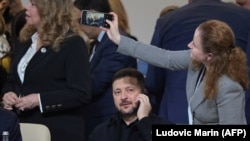
The Russian Foreign Ministry was particularly outraged by Ukrainian President Volodymyr Zelenskyy’s participation in one of those summits and his implicit threats to disrupt the upcoming Victory Day parade in Moscow with long-range drone strikes.
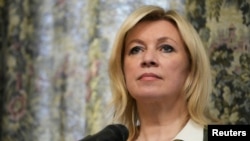
"Russian society, with deep indignation and bewilderment, not only saw but, above all, remembered the fact that Armenia, which we are accustomed to considering a friendly, fraternal country, served as a platform. For whom? For a terrorist,” the ministry spokeswoman, Maria Zakharova, told a weekly briefing.
“And no one in Armenia's current leadership rebuked Zelenskyy," Zakharova said.
Zelenskyy met with Armenian Prime Minister Nikol Pashinian on the sidelines of Monday’s European Political Community (EPC) summit attended by dozens of EU leaders. He said afterwards that Kyiv and Yerevan are “resuming an active dialogue between our countries.”
The EPC gathering was followed by a separate EU-Armenia summit between Pashinian and the EU’s two top officials, Antonio Costa and Ursula von der Leyen. The latter declared that the EU’s ties with the South Caucasus nation traditionally allied to Russia are now “closer than ever.”
“After reading the final declaration of the so-called Armenia-EU summit, it becomes clear that the republic, with the approval of its leadership, is being increasingly drawn into alien, aggressively Euro-Atlantic standards and mechanisms,” charged Zakharova. “This course of action by the Armenian authorities will sooner or later lead to Yerevan's irreversible involvement in Brussels' anti-Russian line, with all the ensuing political and economic consequences for Armenia.”
“Armenia is included in the plans for the militarization of Europe,” the Russian official said without elaborating.
Zakharova went on to claim that Pashinian thus reneged on his pledge to “take no steps against Russia” given to Russian President Vladimir Putin during their April 1 talks in Moscow.
The talks were marked by Putin’s public warnings to Yerevan. Armenia would pay a massive economic price for its government’s continued drift to the EU, Putin implied, noting its heavy dependence on Russia for trade and energy.
Pashinian sought to downplay Russian-Armenian tensions in the following weeks. But one of his top political allies, parliament speaker Alen Simonian, accused Moscow on May 2 of trying to topple Pashinian’s government through Armenian opposition groups running in the June 7 parliamentary elections. Zakharova dismissed the accusations, saying that Simonian made very different statements when he visited Moscow in February.