


Civil Contract pledged to implement relevant “reforms” in its election manifesto reflecting Pashinian’s statements on the subject.
“Once Armenia meets those [EU] standards, EU membership will become a political decision and will depend on whether the EU is ready to accept Armenia,” says the document. “If it is, Armenia will apply to become a full member of the EU. If not, the implementation of the above-mentioned reforms will be a strategic achievement for Armenia as Armenia will have become a country fully compliant with European standards.”
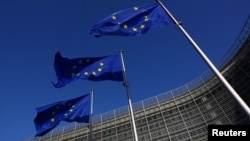
Pashinian’s government enacted last year a law calling for the “start of a process of Armenia's accession to the European Union.” Moscow has since repeatedly warned that this is “not compatible” with Armenia’s continued membership in the Eurasian Economic Union (EEU), a Russian-led trade bloc that gives Armenian exporters tariff-free access to Russia’s vast market.
Putin publicly repeated those warnings when he met with Pashinian at the Kremlin on April 1. He noted that Russia remains Armenia’s most important trading partner and supplies natural gas to the South Caucasus state at a significant discount.
“As you know, energy prices, gas prices in Europe, for example, are currently skyrocketing to over $600 per thousand cubic meters,” Putin told Pashinian. “Russia sells gas to Armenia for $177.5 per thousand cubic meters. The difference is significant.”
That was widely construed as an implicit threat to strip Armenia of economic benefits vital for its economy. Parliament speaker Alen Simonian, responded by saying that Yerevan will leave the EEU if Moscow raises the gas price or imposes other economic sanctions on it.
However, Pashinian and his political allies, including Simonian, downplayed the Russian-Armenian tensions in the following weeks. The Civil Contract manifesto emphasizes that Armenia would remain an EEU member as long as possible.
According to Armenian government data, Russia accounted for 35.8 percent of Armenia’s foreign trade last year, followed by China (12.3 percent) and the European Union (11.7 percent). Its share has increased significantly during Pashinian’s eight-year rule.