


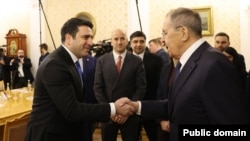
Simonian, who is a leading member of the ruling Civil Contract party, responded to Russian President Vladimir Putin’s stern warnings to Prime Minister Nikol Pashinian publicly issued during their April 1 talks in Moscow.
In particular, Putin warned Armenian authorities against barring what he called pro-Russian opposition groups or politicians from running in Armenia’s upcoming parliamentary elections. He also said Yerevan’s moves to eventually join the European Union are “not compatible” with Armenia’s continued membership in the Eurasian Economic Union (EEU). He noted that Russia remains Armenia’s most important trading partner and supplies natural gas to the South Caucasus state at a significant discount.
“Gas prices in Europe, for example, are currently skyrocketing to over $600 per thousand cubic meters, while Russia sells gas to Armenia for $177.5 per thousand cubic meters,” Putin said in his opening remarks at the talks which continued behind the closed doors.
Russian Deputy Prime Minister Alexei Overchuk followed up on Putin’s warnings in an extensive interview with the official TASS news agency published the next day. Overchuk threatened far-reaching retaliatory measures against what he described as the Armenian government’s efforts to push Russia’s state-owned railway monopoly and other major companies out of Armenia.
“Such talk related to goods [exported to Russia] and the gas prices is not new,” Simonian told reporters. “It has gone on for years. If they make such a decision, Armenia will make its decision and will finally leave both the CSTO (Collective Security Treaty Organization) and the EEU.”
“But I don’t think things will get to that point because I know that there was a very good productive and businesslike conversation between the leaders of the two counties after that [opening exchange,]” he said.
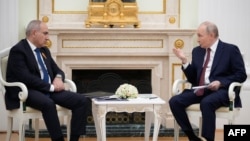
Pashinian on Thursday described his latest trip to Moscow as “very successful,” saying that he and Putin reached unspecified “concrete understandings in all areas of our agenda.” Russian Foreign Minister Sergei Lavrov said, for his part, that the Armenian side “showed understanding” towards the Russian concerns during the talks.
“We'll see how relations develop in practice,” Lavrov told the RIA Novosti news agency over the weekend.
Russia accounted for 35.8 percent of Armenia’s foreign trade last year, followed by China (12.3 percent) and the European Union (11.7 percent). Russian-Armenian trade has skyrocketed in recent years on the back of soaring Armenian exports to Russia.
Economy Minister Gevorg Papoyan, another senior ruling party figure, seemed to downplay on Saturday the economic significane of Armenia’s membership in the EEU, which gives Armenian exporters tariff-free access to Russia’s vast market.
“It’s not that Armenia's economy has experienced astronomical growth since joining the EEU,” said Papoyan.
Armenia joined the Russian-led trade bloc in 2015. According to Armenian government data, its annual exports to Russia have risen more than tenfold, to almost $3 billion, since then. Armenian farmers and food-processing companies are particularly dependent on the Russian market.