



Speaking in parliament, Foreign Minister Ararat Mirzoyan said the government did not report the shipment earlier because it saw no need to give much publicity to the assistance. He did not specify when the aid was sent.
Speaking to reporters after a committee meeting, Mirzoyan emphasized that Yerevan is interested in the “complete preservation of peace” in the region. “We feel sorry also for the brotherly people of Iran, and their neighboring Arab peoples and states are our friends. We are for peace to be established there as soon as possible,” he said.
The conflict between the United States and Israel on one side and Iran on the other began on February 28 after diplomacy over Tehran’s nuclear program failed. The U.S.-Israeli coalition has targeted Iran’s military facilities with missile and air strikes, killing Iran’s supreme leader, Ayatollah Ali Khamenei in the first hours of the attack and decimating the Islamic Republic’s political and military leadership. Iran has responded with missile and drone attacks on Israeli targets and on U.S. military assets across the Middle East, as well as on Washington’s interests and allies in the Gulf region.
The Iranian government has also effectively closed the Strait of Hormuz, a 33-kilometer-wide chokepoint through which roughly a third of the world’s seaborne oil passes. Late last week, U.S. President Donald Trump issued a 48-hour ultimatum to Tehran to reopen the passage, warning that the United States would “obliterate” Iran’s power plants if the strait remained closed.
Officials in Armenia have reacted cautiously to the continuing war that could have far-reaching ramifications for the South Caucasus nation’s security, emphasizing diplomacy as a solution to the conflict.
Armenian Prime Minister Nikol Pashinian has been among the few world leaders who have extended diplomatic gestures toward Tehran during the conflict.
On March 2, Pashinian offered condolences to the Iranian president “on the casualties among the Iranian leadership and citizens,” and on March 9, he congratulated Mojtaba Khamenei on succeeding his killed father as Iran’s supreme leader.
On March 21, the Armenian leader sent congratulations to Mojtaba Khamenei on the Iranian New Year, expressing confidence that “relations between the two friendly countries will continue to develop in the coming year, anchored on sincerity, trust, and mutual respect.” He also wished “lasting peace” to “the friendly people of Iran.” The same day he sent similar Nowruz greetings also to Iranian President Massoud Pezeshkian.
Iran remains a key trading partner for Armenia and one of its two overland routes to international markets.
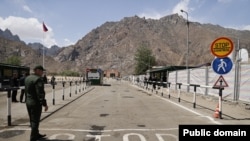
Hundreds of people, both Iranians and citizens of other countries fleeing the war, crossed the land border into Armenia during the first few days of the latest escalation.
Although the Armenian-Iranian border has largely remained open since the outbreak of hostilities, the conflict has reportedly caused a significant drop in cargo traffic between the two countries.
The Armenian prime minister also acknowledged earlier this month that the ongoing Iran war could delay the planned opening of a U.S.-administered transit corridor for Azerbaijan through Armenia.
The regional connectivity project, known as the Trump Route for International Peace and Prosperity (TRIPP), is a key element of the peace agenda agreed by Armenia and Azerbaijan in Washington last year to put an end to more than three decades of conflict over the Nagorno-Karabakh region.