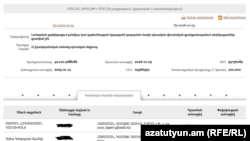





Avet Konjorian, 44, the elder brother of Hayk Konjorian, head of the parliamentary faction of Prime Minister Nikol Pashinian’s ruling Civil Contract party, was fined in early 2026 after being prosecuted for driving while deprived of his license. However, the circumstances under which he received a relatively mild punishment have drawn scrutiny – particularly due to the appearance of a certificate stating he had no prior convictions despite a documented criminal record.
Repeat Offense, Lenient Punishment
According to official court data available on Datalex, the Armenian judiciary’s electronic database, Avet Konjorian was stripped of his driving license for one year in July 2025. Just three months later, patrol officers found him driving a Mercedes, prompting the initiation of criminal proceedings by the Investigation Department of Armenia’s Kotayk province.

Besides a substantial fine, driving while deprived of the right to operate a vehicle carries a range of penalties, including imprisonment of up to one month or community service of up to 150 hours.
However, within weeks, the case was sent to court and resolved through a “fine by agreement,” a procedure permitted under Armenia’s Code of Criminal Procedure for minor, first-time offenses committed by individuals without prior convictions. Avet Konjorian agreed to the arrangement and was fined 375,000 drams (about $1,000), with the court deferring payment after he claimed inability to pay the sum in full. The ruling entered into force on January 29.
“Clean Record” Certificate
Central to the court’s decision was a Form 8 certificate issued by the Police Information Center, stating that Avet Konjorian had no previous convictions. This document allowed the case to qualify for resolution through a fine by agreement, which requires that the accused have no prior criminal record.
However, Avet Konjorian had previously been convicted in 2010 of large-scale fraud. According to that case, he and an associate deceived a resident of the town of Abovian into paying approximately $15,000 under the pretense of purchasing an apartment, then embezzled the funds.
A court found Avet Konjorian guilty and sentenced him to four years’ imprisonment, suspended with a three-year probationary period. The verdict was upheld after prosecutors unsuccessfully sought a harsher sentence. Mitigating factors cited at the time for Avet Konjorian’s suspended sentence included full restitution of the $15,000, the presence of two young children, and character references from neighbors describing him as “a devoted son of the homeland.”
Contradictory Explanations
The presence of a certificate indicating no prior convictions has prompted conflicting explanations from Armenian authorities.
In response to inquiries from RFE/RL’s Armenian Service, the Ministry of Internal Affairs stated that its records do not show any Form 8 certificate indicating the absence of a criminal record that was issued for Avet Konjorian in 2025. The ministry added that it has requested a copy of the certificate from the court for further examination.
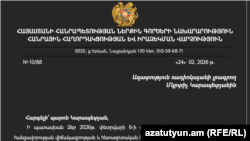
The Investigative Committee, which handled the case, has offered a different account, maintaining that the certificate was indeed obtained from the Crime Statistics and Research Center of the Ministry of Internal Affairs and included in the case file.
The discrepancy leaves unresolved how the document entered the proceedings.
Expungement Argument
Avet Konjorian’s lawyer, Melanya Sargsian, argued that the issue hinges on the legal concept of expungement. She said that for minor or medium-gravity crimes, a conviction is considered expunged after a certain period, after which a person is treated as having no prior convictions.
“It does not matter whether it is Avet Konjorian or anyone else, if the conviction has been expunged, then the person is considered not to have a prior conviction,” she said.
However, the Ministry of Internal Affairs offered a different interpretation. In its response, it stated that Form 8 certificates should include all relevant data about individuals, including their past convictions and expungement status. The ministry emphasized that such records are retained in the operational database regardless of expungement, as stipulated by government Resolution 933-N.
Unanswered Questions
In one of his speeches in parliament in 2021, Hayk Konjorian stressed that “personal relationships and aspects of private life can become the subject of political debate when they in some way affect the public good.”

“We have seen such examples when sons-in-law, godparents, in-laws’ drivers and mistresses have used their positions to harm the public interest,” he said, referring to Armenia’s previous administrations.
RFE/RL’s Armenian Service asked Avet Konjorian’s lawyer whether external influence could have played a role in the appearance of the “clean” certificate, given her client’s family connections. Sargsian dismissed the suggestion.
“No, no, no… don’t look for any interference here. If a person has an expunged conviction, he is considered to have no conviction,” she said.
Avet Konjorian declined to comment on his prior conviction when contacted by RFE/RL’s Armenian Service, ending the phone call.
Beyond the criminal record issue, discrepancies also appear in Avet Konjorian’s employment records. While court documents describe him as unemployed and unable to pay the fine immediately, official records indicate that he continued to serve as director of a real estate company for most of the duration of the court proceedings, leaving the position only several weeks before the ruling entered into force. Presenting Avet Konjorian as unemployed may therefore have led the court to apply a more lenient standard in determining the final fine.