


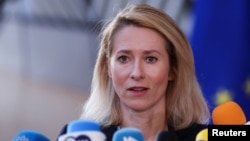
“Following the request from Armenia, the EU will deploy a Hybrid Rapid Response Team to help counter the threats ahead of the country’s elections,” Kaja Kallas, the EU’s High Representative for Foreign Affairs and Security Policy, told a press conference after a meeting of the EU Foreign Affairs Council.
“Supporting democratic resilience in our neighborhood remains essential. We will not leave Armenia to face foreign interference alone. Democracies under pressure can count on Europe,” she added.
RFE/RL’s Armenian Service had earlier reported that the EU was considering such a deployment following a request from Yerevan outlined in a letter by Armenia’s foreign minister seen by RFE/RL.
The EU first announced in December that it was preparing to allocate 12 million euros (about $13.8 million) to Armenia to help it “counter Russian disinformation ahead of the elections.” Kallas later said that the assistance had been requested by the Armenian government.
According to a document seen by RFE/RL’s Armenian Service, the EU will deploy a team of between 9-14 experts in Armenia in late March/early April for the duration of 10-15 working days to help Yerevan counter hybrid threats and Foreign Interference and Manipulation of Information (FIMI).
The team will provide advice to the offices of the Armenian Prime Minister and the Security Council “on crisis management plans” and support “in shaping future crisis management protocols, including on cyber and FIMI.” The Central Election Commission, the Interior Ministry, and tax authorities will also be among the beneficiaries of the assistance.
The EU believes that Armenia has been facing “intense hybrid activities, with concerns over an intensification of actions taken by adversaries to undermine democratic institutions, processes and societal trust.”
“These threats are highly likely to escalate further in the run up to the elections on 7 June 2026,” the document approved by the Council of the European Union states.
The document makes it clear that Armenia appealed to the EU last November, after which an assessment mission was organized in January, and that “these efforts provided valuable insights into the country’s vulnerabilities to hybrid threats.” It does not mention specific examples.
The planned deployment has drawn criticism from Armenia’s opposition, which has described the move as interference in the country’s domestic political affairs.
Russia has also criticized the EU’s plans. Maria Zakharova, a spokesperson for the Russian Foreign Ministry, claimed earlier this month that the EU was gearing up for a repeat of “the Moldovan scenario” in Armenia.
The EU previously sent a similar mission to Moldova during parliamentary elections held there last September. In those elections, two opposition parties described as pro-Russian were barred from running, while authorities reportedly blocked Russian or pro-Russian websites accused of spreading election-related disinformation.
Armenian officials have rejected the criticism, saying the request for EU assistance is intended to ensure the proper conduct of the elections rather than influence their outcome.
Armenian Prime Minister Nikol Pashinian’s ruling Civil Contract Party is seeking to retain its strong majority in parliament in the elections scheduled for June 7. Several opposition groups, including the newly established Strong Armenia party led by Russian-Armenian businessman Samvel Karapetian, say they aim to unseat the ruling party and form the next government.