


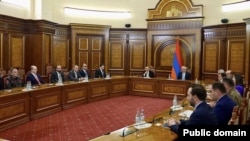
In a statement to the official Armenpress news agency, Armenia’s Foreign Intelligence Service (FIS) said they are being told to take financial, “organizational” and other actions for that purpose. The FIS did not name that country or Armenian opposition groups allegedly supported by the foreign power. Nor did it give other details.
The Interior Ministry said a few hours later that that the Armenian police have already looked into the FIS statement and submitted a relevant “report of an apparent crime” to another law-enforcement agency, the Investigative Committee. The latter declined to say whether it has launched a formal criminal investigation and identified any suspects.
A deputy chairman of Prime Minister Nikol Pashinian’s Civil Contract party hinted, meanwhile, that Russia is the source of the alleged meddling in the elections scheduled for June 7. Vahagn Aleksanian claimed that Armenians living abroad will be ordered to travel to their home country to vote in the polls.
Pashinian himself spoke at the weekend of rumors that “they will be bringing people from Russia” to vote for the opposition.
“Let them bring [such people] because 84.5 percent of those who will come, according to the polls we have conducted there, will vote for us,” he said during a campaign trip to Gyumri.
The allegations came almost one month after Pashinian’s government formally asked the European Union to send a “hybrid rapid response team” to Armenian ahead of the elections. The EU seems intent on deploying such a mission to counter possible Russian interference.
Yerevan’s request added to Armenian opposition concerns about the freedom and fairness of the vote. Opposition leaders say that under the guise of countering Russian “hybrid threats,” Pashinian is trying to secure an EU blank check for winning it through fraud or foul play.
The EU sent a similar mission in Moldova during parliamentary elections held there last September. Two Moldovan opposition parties deemed pro-Russian were barred from running in the elections won by the former Soviet republic’s pro-Western leadership. Armenian opposition groups fear that some of them may likewise be disqualified from the race with the EU’s backing.
In recent weeks, senior members of Pashinian’s party have signaled concerns that three such groups led by former President Robert Kocharian, Russian-Armenian billionaire Samvel Karapetian and another wealthy businessman, Gagik Tsarukian, may collectively win a majority in the next Armenian parliament and form a coalition government. They have said that the Armenian authorities “will not allow” such an outcome.