




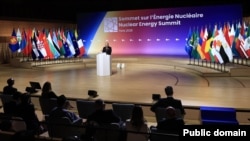
Pashinian made no mention of a U.S.-Armenian nuclear agreement finalized last month when he addressed the global Nuclear Energy Summit in Paris organized by the French government and the International Atomic Energy Agency (IAEA).
“Armenia has made a decision to pursue small modular reactor technology,” he said in a speech. “Currently, we are carefully examining technologies and assessing proposals from international partners. The selection process is guided by the consideration of reliability, long-term sustainability and our commitment to the highest standards of nuclear safety, security and non-proliferation.”
Pashinian and U.S. Vice President JD Vance signed a joint statement on the “completion of negotiations” on the agreement after their talks in Yerevan on February 9. It was widely construed as a further indication that the Armenian government wants to rely on the United States in its ambitious plans to replace Metsamor nuclear plant with a modern facility equipped with small modular reactors (SMRs), a new and relatively untested technology.
“American technology is going to be coming to this country,” Vance told reporters after the talks.
“That means up to $5 billion in initial U.S. exports, plus an additional $4 billion in long-term support through fuel and maintenance contracts,” he said, clearly alluding to the construction of the new Armenian nuclear plant.

Russian officials expressed concern at such a prospect in the following days. Sergei Shoigu, the secretary of Russia’s Security Council, argued on February 13 that the U.S. itself does not yet have a functioning SMR plant. He claimed that the possible construction of such a facility in Armenia would therefore pose an environmental threat to not only the South Caucasus country but also Russia.
Narek Apitonian, Armenia’s deputy minister of territorial administration and infrastructures, told RFE/RL’s Armenian Service on February 16 that Yerevan is still weighing up various options for implementing its nuclear project. Pashinian similarly downplayed the nuclear agreement with the U.S. when he spoke to reporters on February 13. He said it will only give Armenia access to “complete information about the modular reactor technologies that the United States has.”
The $9 billion in total funding cited by Vance nearly matches Armenia’s entire state budget for this year. Pashinian’s domestic critics say a U.S.-led nuclear project is therefore too expensive for the country. Some of them claim that Pashinian is using the issue for geopolitical purposes.
The Metsamor plant’s sole functioning reactor produces around one-third of the country’s electricity. It is due to be decommissioned in 2036.