


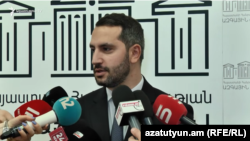
Ruben Rubinian, who is also a deputy speaker of the Armenian parliament, continued to stress the need to prevent their victory amid opposition concerns over the freedom and fairness of the elections scheduled for June 7.
“We believe that the coming to power of Kocharian and the two oligarchs [Samvel Karapetian and Gagik Tsarukian] is a bad thing and must be prevented,” Rubinian said.
He claimed that they will tolerate corruption if they collectively defeat Prime Minister Nikol Pashinian’s party and form a government.
Pashinian declared on February 13 that there will be no former presidents and “oligarchs” in the Armenian political arena after the elections. His political allies, notably Rubinian, have since been saying that Kocharian, Karapetian and Tsarukian aim to replicate the opposition victory in municipal elections held in Gyumri almost a year ago.
Civil Contract won most votes but fell well short of a majority in the local council empowered to appoint the mayor of the country’s second largest city. The mayor was installed by four opposition groups that participated in the elections separately.
“How should the implementation of this scenario be prevented? People must give zero votes to Kocharian and the two oligarchs,” Rubinian told reporters on Tuesday.
He did not say just how Pashinian’s party will go about achieving such an outcome. He said it is aiming for a two-thirds majority in the next National Assembly.
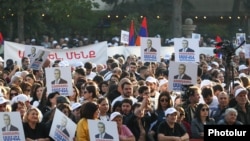
Opposition representatives claim that Pashinian is afraid of losing the showdown vote and may simply bar the three opposition groups or at least some of them from running in it.
“I advise them to already publish a list of those whom they are not going to allow to participate in the elections,” a spokeswoman for Tsarukian told RFE/RL’s Armenian Service on Friday.
Pashinian was already accused by other critics of planning to secure an election victory through fraud or foul play when it emerged in December that his administration requested election-related assistance from the European Union. The EU foreign policy chief, Kaja Kallas, revealed that Yerevan is seeking the kind of “help to fight foreign malign interference” which the EU provided to Moldova ahead of parliamentary elections held there in September 2025.
Two Moldovan opposition parties deemed pro-Russian were barred from participating in the elections won by the country’s pro-Western leadership. The EU justified those bans, alleging Russian interference in the Moldovan elections. Moscow strongly denied that.