


In an unprecedented joint statement circulated late on Thursday, they said the campaign accompanied by arrests and indictments of senior clergymen poses “direct threats to all Armenians around the world” and could cut the Armenian government’s ties with the worldwide Diaspora. They stressed that the church branches in and outside Armenia continue recognize Garegin as their “global leader.”
The signatories include four wealthy businessmen and philanthropists -- Noubar Afeyan, Vatche Manoukian, Vahe Gabrache and Joseph Oughourlian -- as well as British-Armenian surgeon Ara Darzi, Armenian-American physician Eric Esrailian, former Armenian Assembly of America Co-Chair Anthony Barsamian and Berge Setrakian, the former president of the Armenian General Benevolent Union (AGBU), the largest Diaspora charity.
“Persistent attacks on the Church leadership, and the threatened forcible or mandated removal of its leader, pose direct threats to all Armenians around the world who rely on the Church for spiritual sustenance,” read their statement. “We call for all matters related to church governance to be addressed through the governance structures of the Church, which have functioned now for 18 centuries in accordance with the teachings and traditions of the Armenian Apostolic Church.”
“It is the Church that helped the population survive and revive in the period after the [1915] Genocide; the Church that helped resurrect the Armenian soul; and the same Church that is needed for a globally dispersed ancient nation to thrive,” it said. “Even if unintentional, the Armenian government’s approach is risking severing its relationship with the diaspora – something not even the Ottoman Empire or the Soviet Union were able to do.”
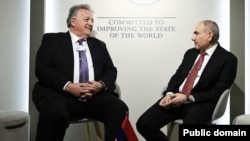
The statement also warned: “As current citizens of the United States and many other countries, diasporan Armenians are obliged to seek the assistance of our own governments – including political remedies and legal actions if necessary – in protecting our religious rights. These rights include the Armenian Apostolic Church’s reliance on self-governance with established canons and traditions dating back to the earliest days of Christianity.”
Pashinian reacted furiously to the statement on Friday, alleging that its signatories want to “take the Catholicosate out of Armenia together with the treasures of Echmiadzin.”
“The whole thing is about taking the Catholicosate out of Armenia, and I will not allow that. If additional measures need to be taken for that, they will be taken,” he said in an apparent threat to prevent Garegin and bishops and archbishops of the church from holding an emergency meeting in Austria scheduled for February 16-19.
The meeting was originally scheduled to take place in Echmiadzin from December 10-12. Garegin postponed it because of what the church’s Mother See described as “repressions against clergy.” The prominent Diaspora Armenians stressed the significance of the planned meeting in their joint statement.
On January 31, an Armenian law-enforcement agency indicted six more bishops and archbishops and banned them from leaving the country pending investigation. The move was widely construed as an attempt to scuttle the gathering. Pashinian’s latest comments suggest that the Catholicos too may be barred from flying to Austria.
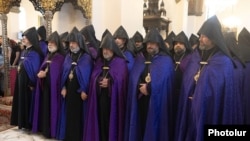
Pashinian began his campaign last May right after Garegin accused Azerbaijan of committing ethnic cleansing in Nagorno-Karabakh, destroying the region’s Armenian churches and illegally occupying Armenian border areas during an international conference in Switzerland. The premier’s detractors say he wants to please Azerbaijan or neutralize a key source of opposition to his unilateral concessions to Armenia’s arch-foe.
Pashinian said until December that Garegin and other top clerics at odds with him must go because they had secret sex affairs in breach of their vows of celibacy. He has given a different reason for his campaign since then, accusing them of spying for a foreign country, presumably Russia. He has not offered any proof of the allegation publicly dismissed by Russian Foreign Minister Sergei Lavrov on January 20.
Pashinian went further in televised remarks aired on Tuesday, comparing the church leadership to radical Islamists pursuing political goals.
“Since 2020, political and, I would say, radical texts have been heard during sermons in almost all churches in Armenia,” he told state television. “I hope my comparison sounds correct, but do you know that in many countries, there are also manifestations of extremist Islam?”