


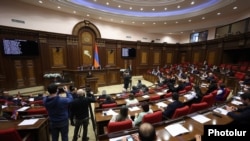
The bill passed in the first reading empowers the state Commission on Television and Radio (HRH), a regulatory body dominated by government loyalists, to ban foreign broadcasters deemed to be meddling in Armenia’s internal political developments.
Russian state TV channels are believed to be its principal target. The Armenian government has repeatedly threatened to block their broadcasts in response to their reports critical of Prime Minister Nikol Pashinian. The HRH already banned in March 2024 the retransmission of a daily political talk show aired by one of those channels.
Opposition lawmakers voted against the bill. They argued that it sets no clear criteria for accusing foreign news organizations of interference in the country’s internal affairs.
“How are you going to check and measure that interference?” one of them, Gegham Manukian, asked Minister of High-Technology Industry Mkhitar Hayrapetian during a parliament debate on Thursday.
“In my opinion, television content interfering in Armenia’s domestic political life is an informational, analytical or propaganda program that directly or indirectly aims to influence the domestic political processes in Armenia, including the formation of government, elections or referendums, the activities of political parties or movements, and the formation of public opinion on domestic political issues,” Hayrapetian said vaguely.
Artur Papian, the chairman of the Yerevan Press Club, also criticized the new powers given to the HRH as disproportionate, arbitrary and unjustified.
“What does it mean to interfere in internal affairs through one’s media?” Papian told RFE/RL’s Armenian Service. “It’s clear that in an electoral environment any information can be portrayed as electoral interference. But the function of the media is precisely this: to intervene, so to speak, to guide and help citizens make the right choice.”
Some critics link the controversial measure to Armenia’s parliamentary elections scheduled for June 7. Pashinian’s administration has implicitly accused Moscow of trying to undercut it ahead of the vote and asked the European Union to help it counter Russian “hybrid threats.” Russian Foreign Minister Sergei Lavrov publicly deplored those claims when he met with Armenian parliament speaker Alen Simonian in Moscow last week.
The Armenian opposition has also dismissed them, saying that Pashinian is simply seeking the green light from the EU to disqualify opposition groups from the elections or rig them otherwise. Pashinian has repeatedly branded his political foes as Russian agents.