



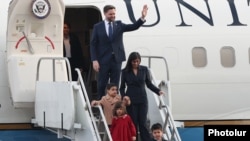
He went straight into talks with Armenian Prime Minister Nikol Pashinian after landing at Yerevan’s Zvartnots airport.
Announcing the trip late last month, U.S. President Donald Trump said Vance will specifically “advance” one of those agreements which calls for the opening of a U.S.-run transit corridor that would connect Azerbaijan to its Nakhichevan exclave through Armenia’s Syunik region.
U.S. Secretary of State Marco Rubio and Armenian Foreign Minister Ararat Mirzoyan released the first major details of what will be called the Trump Route for International Peace and Prosperity (TRIPP) after meeting in Washington on January 13. A joint U.S.-Armenian “implementation framework” confirmed that a special company controlled by the U.S. government will build a railway, a road, energy supply lines and other infrastructure along Armenia’s border with Iran and manage them for at least 49 years.
Armenian opposition leaders have expressed serious concern over the TRIPP, saying that it could undermine Armenian control over that part of Syunik. They claim that Pashinian has accepted Baku’s demands for the movement of people through the corridor to be exempt from Armenian face-to-face border checks. Meeting with Trump in Davos on January 22, Azerbaijani President Ilham Aliyev likewise said the TRIPP amounts to the kind of an extraterritorial “Zangezur corridor” that is sought by Baku.
Speaking to Armenian state television at the weekend, Deputy Foreign Minister Vahan Kostanian said Vance will also discuss in Yerevan U.S.-Armenian cooperation on nuclear energy and extraction of “critical minerals.”
“It's not just about copper,” he said. “In the case of Armenia, we still have to do some research to understand which of these minerals are in our soil, and we hope that our partners in the United States ... will help us discover the capabilities that we have.”
Pashinian reaffirmed late last year his government’s declared plans to build a new nuclear plant to replace Armenia’s aging facility at Metsamor. But he again did not give any time frames for the implementation of the ambitious project.
Both the U.S. and Russia have shown an interest in the project requiring billions of dollars in investment. Pashinian’s administration has signaled its preference for the U.S. amid lingering tensions with Moscow.