



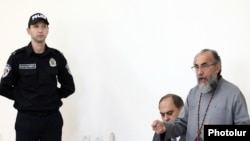
Archbishop Mikael Ajapahian was arrested on June 27 the day after Pashinian threatened to forcibly remove the supreme head of the Armenian Apostolic Church from his Echmiadzin headquarters. He was charged with calling for a violent overthrow of the Armenian government.
The case against the 63-year-old cleric is based on a June 2025 interview in which he lamented the Armenian military’s failure to topple Pashinian and thus “save” Armenia and Nagorno-Karabakh following the 2020 war with Azerbaijan. The Office of the Prosecutor-General had concluded that similar remarks made by him in previous years do not warrant criminal charges.
Ajapahian, who heads the church diocese in Armenia’s Shirak province, rejected the accusation as politically motivated during his unusually quick trial which ended in October in a two-year prison sentence. He appealed against the verdict handed down by a court of first instance.
Citing Ajapahian’s health issues, his lawyers petitioned the Court of Appeals earlier this week to move him to house arrest pending a final verdict on the high-profile case. The court granted the request.
In December, prison authorities reluctantly allowed Ajapahian to undergo urgent surgery at a Yerevan hospital of his choice, the Izmirlian Medical Center. The archbishop known as a vocal critic of Pashinian remains in the hospital owned by the church.

Ajapahian was taken into custody two days after Archbishop Bagrat Galstanian and his 15 supporters were arrested on charges of plotting “terrorist acts” in a bid to seize power. They all deny the charges. In October, the authorities arrested Bishop Mkrtich Proshian, Garegin’s nephew heading another church diocese. They claim that Proshian had forced his subordinates to attend opposition rallies in Yerevan, a charge he strongly denies.
The crackdown on clergy loyal to the Catholicos continued with the arrest on December 4 of Archbishop Arshak Khachatrian, the head of the church’s Mother See Chancellery in Echmiadzin. Khachatrian is facing drug-related charges rejected by him as politically motivated.
On January 31, the Investigative Committee also indicted six other archbishops and bishops for recommending the recent defrocking of another bishop who broke ranks in November to join Pashinian’s campaign. The law-enforcement agency did not arrest them. Still, it banned them from leaving Armenia to attend an emergency conference of the church’s top clergy in Austria. Their lawyers and the church’s Mother See believe Pashinian is thus trying to scuttle the conference scheduled for February 16-19.
Like other critics of Pashinian, they maintain that the prime minister’s drive to depose Garegin violates Armenia’s constitution and laws guaranteeing the autonomy of the ancient church and its separation from the state. Earlier this week, two Western religious rights groups echoed these claims denied by Pashinian. One of them, the Vienna-based the Forum for Religious Freedom Europe, spoke of “grave threats to freedom of religion or belief” in Armenia.