



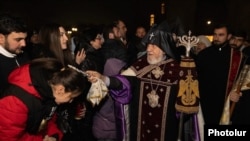
Bishop Gevorg Saroyan was defrocked late on Tuesday more than two weeks after being dismissed as head of the church’s Masyatsotn Diocese encompassing parts of Armenia’s southern Ararat province. With Pashinian’s encouragement, Saroyan refused to obey the decision and went on to challenge it in court.
In an unprecedented injunction, a district court ruled on January 16 that Saroyan must be reinstated pending its verdict on the lawsuit. It also said the church must not try to stop him from performing his duties in any way.
The church’s Mother See and legal experts dismissed the order, saying that Armenian courts have no jurisdiction over the Catholicos’s unlimited authority to name and replace diocese heads. They argue that Armenian priests serve based on their vows to obey the church’s centuries-old canonical rules, rather than employment contracts.
The courts have never ruled before on decisions made by the current or previous Catholicoses. No such judicial acts were known even in Soviet times.
Saroyan’s defrocking led the Investigative Committee to launch a criminal investigation into noncompliance with a judicial act, a crime punishable by up to two years in prison. The law-enforcement agency did not formally charge Garegin or anyone else, saying instead that “procedural and evidentiary actions are being carried out” as part of the investigation.
Marine Farmanian, a lawyer critical of the Armenian government, laughed off the criminal proceedings.
“No sane lawyer will react to that without a laughter,” Farmanian told RFE/RL’s Armenian Service.
“The court has no right to order anything to the Mother See or make other decisions regarding it,” she said. “A secular court can’t deal with ecclesiastical rules.”
Pashinian claimed the opposite when he spoke to reporters just a few hours before the announcement of the probe. He said the church “mut reckon with legal conclusions” drawn by relevant authorities.
Pashinian again denied growing opposition accusations that he is abusing his powers and violating Armenia’s constitution in his drive to oust Garegin. His critics say that the campaign violates constitutional provisions guaranteeing the autonomy of the ancient church and its separation from the state.
Last month, Pashinian effectively admitted ordering the National Security Service (NSS), the former Armenian branch of the Soviet KGB secret police, to try to censor church liturgies attended by him. He also said earlier that intelligence briefings presented to him by the NSS contain sensitive details of the private lives of Armenian priests.
Saroyan is one of the ten archbishops and bishops who openly added their voice to Pashinian’s demands for Garegin’s resignation in November. Four other senior clergymen, who are loyal to the Catholicos and very critical of Pashinian, were arrested last year on different charges rejected by them as politically motivated. Garegin’s supporters fear that he too may eventually be arrested.