

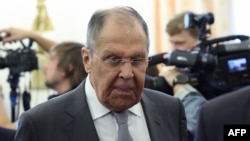
Lavrov again pointed to EU foreign policy chief Kaja Kallas’s remarks made just before she and the foreign ministers of EU member states met with their Armenian counterpart Ararat Mirzoyan in Brussels last month. Kallas said the Armenian government has asked for the kind of “help to fight foreign malign interference” which the EU provided to Moldova ahead of elections held there in September.
Two pro-Russian Moldovan opposition parties were barred from participating in those polls won by the country’s pro-Western leadership. The EU alleged Russian interference in them when it justified those bans. Moscow denied the allegations. Lavrov charged on Tuesday that the Moldovan elections were marred by “blatant falsifications.”
“If the head of European diplomacy, Kaja Kallas, openly admits that the Moldovan scenario will be applied during the upcoming elections in Armenia, then if I were in the shoes of Armenian society, I would seriously think about it,” he told a news conference in Moscow.
Armenian opposition leaders have also expressed concern about the election-related assistance requested from the EU by Prime Minister Nikol Pashinian’s government. They claim that Pashinian hopes to secure the EU’s backing for winning the showdown elections slated for June through fraud or foul play.
The Armenian Foreign Ministry insisted last month that Yerevan only wants the EU to help it “counter potential hybrid threats” to the proper conduct of the upcoming vote. Pashinian and his political allies have implied that those threats emanate from Russia. Lavrov dismissed their implicit claims.
“Rapprochement with the European Union is not without consequences because it is the European Union that constantly talks about hybrid threats generated by the Russian Federation and provides funds for such work,” he said. “Armenia was recently granted a 15 million-euro tranche, and I have no doubt that the Brussels bureaucracy will force our Armenian friends to earn every cent [of that assistance.]”
Kallas announced that extra aid after meeting with Mirzoyan earlier in December. She said part of it will be spent on countering “disinformation” spread by Russia.
Lavrov also repeated Moscow’s concerns over a new policy framework for deepening Armenia’s relations the European Union which was signed in Brussels by Mirzoyan and Kallas on December 2. The document highlighted the Pashinian administration’s plans to seek Armenia’s membership in the 27-nation bloc. Yerevan maintains that it does not yet intend to leave the Eurasian Economic Union (EEU), a Russian-led trade bloc that gives Armenian exporters a tariff-free access to Russia’s vast market.
“Movement towards membership in the European Union cannot be combined with maintaining membership in the Eurasian Economic Union,” Lavrov said, echoing warnings repeatedly issued last year by other Russian officials.
According to Armenian government data, Russia remained Armenia’s most important commercial partner in January-November 2025. It accounted for 35.5 percent of the South Caucasus country’s overall foreign trade, followed by China (12.5 percent) and the EU (11.8 percent).