



Bishop Gevorg Saroyan is one of the ten senior clergymen who openly broke the ranks in late November to join in Prime Minister Nikol Pashinian’s controversial campaign to oust the supreme head of the church. While condemning their defections, Garegin was careful until this weekend not to take punitive measures against any of them.
The church’s Mother See in Echmiadzin announced on Saturday that Saroyan has been dismissed as primate of the Masyatsotn Diocese encompassing the town of Masis and other parts of the southern Ararat province. With Pashinian’s encouragement, Saroyan refused to obey the decision.
“Ktrich Nersisian (Garegin’s original name) is not the Catholicos of All Armenians, and therefore the decisions he makes from that position have no value for us and are null and void,” Pashinian said in a social media post that sparked more opposition accusations of illegal meddling in the church’s affairs.
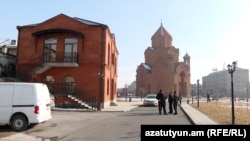
Pashinian underlined his support for Saroyan by attending a Sunday mass in St. Thaddeus’s Church in Masis led by the renegade bishop. The service took place amid heavy police presence in and around the church the adjacent to the primate’s headquarters.
Scores of police officers continued to guard both buildings on Monday. An Armenian Interior Ministry spokesman said that they were deployed to “maintain public order” there. Critics believe, however, that the police deployment is aimed at preventing Saroyan’s temporary replacement appointed by the Mother See, Rev. Ruben Zargarian, from entering the premises.
Zargarian has made no such attempts so far. He has instead been visiting various diocese parishes and meeting with their priests. Only four of the 24 priests serving at in the Masyatsotn Diocese have voiced support for Saroyan.
The Armenian police already prevented clerics loyal to the Catholicos from holding late last year and earlier this month services at two other churches effectively controlled by defrocked pro-government priests. Another law-enforcement agency, the National Security Service, reportedly pressured other priests to defy Garegin II during liturgies.
The Mother See as well as opposition figures and other critics of Pashinian have accused the authorities of violating constitutional provisions guaranteeing the independence of the ancient church and its separation from the state. Pashinian stoked these accusations when he issued on January 3 a joint statement with the renegade bishops in which he pledged to keep up the pressure on Garegin II in his official capacity as prime minister.
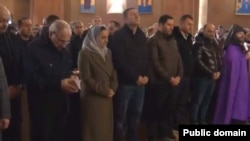
Since November, Pashinian has made a point of attending masses held by defrocked and/or pro-government priests and attended by many senior officials, ruling party figures and public sector employees. Scores of such employees were spotted in the Masis church on Sunday.
Many of them were understood to work for the local government of the Vedi district of the Ararat province run by a senior member of Pashinian’s Civil Contract party. One middle-aged man told reporters that he and fellow workers of the local utilities department were “required” to come to the Masis church on the occasion. He said he obliged despite receiving treatment in a hospital.
“Now I have to go back to the hospital,” the man added in remarks widely circulated by independent and pro-opposition media.
The remarks led Daniel Ioannisian, an activist heading a Western-funded nongovernmental organization, to demand a criminal investigation into what he sees as an apparent “coercion” punishable by the Armenian Criminal Code.
Artur Sakunts, a human rights activist who has rarely criticized government crackdowns on the opposition, also expressed concern about the presence of a large number of public sector workers at liturgies attended by Pashinian. Sakunts suggested that they go to those services for fear of losing their jobs.
“This may indicate a systematic abuse of [the government’s] administrative resources,” he told RFE/RL’s Armenian Service.