



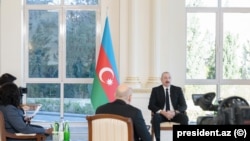
“The Zangezur corridor will be opened,” Aliyev told Azerbaijani media in a televised interview publicized late on Monday. “It may have a different name. But that doesn’t change its essence.”
“In the process of the normalization of relations with Armenia all major issues have been resolved the way we wanted,” he said.
Aliyev cited one of the documents signed by him, Armenian Prime Minister Nikol Pashinian and U.S. President Donald Trump during their talks held in Washington in August. It envisages that Yerevan will give the United States exclusive rights to a transit railway, road and possibly energy supply lines that would connect Nakhichevan to the rest of Azerbaijan through Armenia’s strategic Syunik province. Key practical modalities of what will be named the Trump Route for International Peace and Prosperity (TRIPP) remain unknown.
Pashinian’s domestic critics maintain that the TRIPP amounts to the kind of corridor that has been demanded by Baku ever since the 2020 war in Nagorno-Karabakh. Aliyev repeatedly echoed these claims following the Washington talks. Addressing the UN General Assembly in September, he said that the TRIPP will ensure Azerbaijan’s “unimpeded access through the Zangezur corridor” to Nakhichevan.
Pashinian complained two days later that this statement runs counter to the deal brokered by Trump and is “perceived as a territorial claim” in Armenia. Azerbaijani officials kept using the term even after Pashinian raised the matter with Aliyev during their October 2 meeting in Copenhagen.
“If we look at the content of [Armenian-Azerbaijani] documents, including the August 8 document, we will see that unfortunately Azerbaijan’s statements are significantly, if not fully, close to reality,” said Hakob Badalian, an Armenian political analyst.
The TRIPP would run along Armenia’s vital border with Iran. Tehran fears that it could put the Armenian-Iranian border at serious risk and lead to U.S. security presence there.
“The so-called Trump plan regarding the Caucasus is no different from the Zangezur Corridor, and the Islamic Republic is absolutely opposed to it,” a top aide to Iran’s Supreme Leader Ayatollah Ali Khamenei told the Armenian ambassador in Tehran last month.
Pashinian and other Armenian officials downplayed that warning. They claimed that Yerevan is addressing Tehran’s concerns.