





Prime Minister Nikol Pashinian rallied, meanwhile, supporters in Yerevan to urge Armenians, who mark Christmas on January 6, to help him depose the supreme head of the church.
“Our Holy Church continues to be subjected to repression,” Garegin said during the liturgy. “This situation is a serious blow to the authority of our nation and state and a deep wound inflicted upon communities and believers. Despite unlawful and anti-canonical actions, our Holy Church, together with its devout people, remains firm and unshaken, faithful to its God-given calling and mission.”
“Throughout the course of history, our Apostolic Mother Church has been subjected to numerous assaults, has passed through dreadful trials and sufferings, has been martyred and sacrificed, yet has never become captive to despair, for she has understood that true freedom and salvation are found in obedience to Christ and in placing trust in Him,” he told worshippers that packed the ancient cathedral.
As he spoke, Pashinian attended a Christmas mass at Yerevan’s St. Gregory the Illuminator Cathedral together with senior state officials and members of the ruling Civil Contract party. The service there was led by one of the ten bishops who openly broke ranks in late November to join in the premier’s controversial campaign to oust Garegin.
After the service, Pashinian led several thousand people, who reportedly included public sector employees, on a march to another church in the city center. Addressing the crowd there, he again declared that the church must be “liberated” from its Catholicos elected by a pan-Armenian assembly of clerics and laymen in 1999.
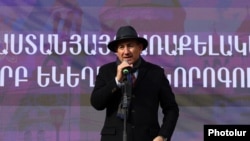
“They keep saying that the government is acting against the church,” he said. “The government did not and will not act against the church because the government is a follower of the Armenian Apostolic Holy Church. We have come here to only note that some attempt to use the church as a platform against the state. And I, as the elected prime minister of Armenia, say that we will not allow that.”
“The church is not alone because the church and the state are together from now on,” he added in remarks bound to spark more opposition accusations of abuse of power.
The Armenian constitution guarantees the autonomy of the church and its separation from the church. Pashinian was again accused of violating this constitutional provision after signing on Sunday night a joint statement with the renegade bishops in which he pledged to keep trying to oust Garegin in his official capacity as prime minister.
Pashinian on Tuesday urged Armenians to back his “reform agenda” by attending liturgies and telling priests not to utter Garegin’s name in line with a centuries-old ecclesiastical rule. But he again refrained from calling on them to converge on the Echmiadzin cathedral in a bid to force Garegin into resignation.

The rebel bishops loyal to Pashinian held such a gathering outside the cathedral on December 18. But its participants were greatly outnumbered by thousands of other people, many of them opposition backers, who rallied there in support of the Catholicos.
Pashinian first threatened to forcibly remove Garegin from his Echmiadzin headquarters in late June. He said afterwards that his supporters must be prepared to rally there for that purpose. Opposition groups responded by urging their loyalists to be ready to rush to Echmiadzin and defend the embattled church head.
Three archbishops and one bishop loyal to Garegin were arrested from June through December on various charges rejected by them as politically motivated. One of them, Archbishop Bagrat Galstanian, led in 2024 massive antigovernment protests in Yerevan sparked by Pashinian’s territorial concessions to Azerbaijan. The premier and his political allies accused the church of meddling in politics during and after those protests.
Pashinian began attacking the church’s top clergy in late May 2025 right after Garegin accused Azerbaijan of committing ethnic cleansing in Nagorno-Karabakh, destroying the region’s Armenian churches and illegally occupying Armenian border areas during an international conference in Switzerland. His domestic critics say that his campaign is aimed at pleasing Azerbaijan and/or neutralizing a key source of opposition to his unilateral concessions to Armenia’s arch-foe.