


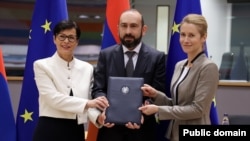
The new Strategic Agenda for the EU-Armenia Partnership was signed in Brussels on December 2. It is meant to build upon the Enhanced Partnership Agreement (CEPA) signed by Brussels and Yerevan in 2017.
“Cooperation is one thing and integration quite another,” Russia’s Deputy Foreign Minister Mikhail Galuzin told the Izvestia daily in an interview published on Tuesday. “What we see in the new strategic agenda for Armenia-EU partnership is precisely integration, as we understand it, which includes harmonizing Armenia's legal framework with relevant EU standards in key areas such as politics, security, economics, energy, ecology, and so on.”
“And we are telling our Armenian colleagues frankly and openly that such harmonization of the legal framework with the EU will inevitably conflict with the relevant norms of the Eurasian Economic Union (EEU), of which Armenia is a member,” he said.
The Russian ambassador in Yerevan, Sergei Kopyrkin, likewise indicated Moscow’s unhappiness the 64-page document signed by EU foreign policy chief Kaja Kallas and Armenian Foreign Minister Ararat Mirzoyan. Kallas, he said, made clear that the 27-nation bloc expects Armenia to join the EU’s sanctions imposed on Russia following its invasion of Ukraine.
“The EU's top brass makes no secret of their intentions to frame EU relations with Yerevan in the context of their plans to inflict a ‘strategic defeat’ on Russia, Armenia's ally,” Kopyrkin told the Russian-Armenian newspaper Noev Kovcheg.
Russian officials issued similar warnings after the Armenian government pushed through the parliament in April a law calling for the “start of a process of Armenia's accession to the European Union.” They warned that Armenia risks losing its tariff-free access to Russia’s vast market and having to pay much more for Russian natural gas and foodstuffs.
Yerevan maintains that it does not intend to leave the EEU. Prime Minister Nikol Pashinian attended last week a summit in Saint Petersburg of the leaders of Russia and four other ex-Soviet states making up the trade bloc.
Pashinian stated this summer that Armenia will eventually have to choose between the EU and the Russian-led bloc. Russia accounted for over 35 percent of Armenia’s foreign trade in the first half of this year, compared with the EU’s 12 percent share.
Galuzin emphasized increased Russian-Armenian trade and other “huge benefits” of Armenia’s membership in the EEU.
“For example, when Armenia joined the EEU in 2015, its GDP was around $10.5 billion, while today it is already $26 billion,” argued the Russian diplomat.