


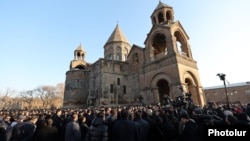
In a weekend statement, the U.S.-based legal think-tank said Prime Minister Nikol Pashinian’s drive to depose the supreme head of the church, Catholicos Garegin II, “endangers not only freedom of religion but also the cultural and existential security of the Armenian people.”
“The marginalization of the Apostolic Church, the very institution that has historically embodied national resilience, mirrors the strategies historically used by Ankara and now Baku to undermine Armenian identity and cohesion,” read the lengthy statement. “If unchecked, this alignment risks eroding the moral and cultural foundations that have safeguarded Armenian survival for centuries, effectively advancing the objectives of powers that have sought to weaken Armenia’s independence and unity.”
“The Lemkin Institute calls on the Armenian government to immediately cease all politically motivated actions against the clergy and to reaffirm its commitment to the constitutional principles of religious freedom and pluralism,” added the statement.
Pashinian’s domestic critics similarly maintain that his campaign is aimed at pleasing Azerbaijan and/or neutralizing a key source of opposition to his unilateral concessions to Armenia’s arch-foe. The Armenian premier began attacking the top clergy in late May right after Garegin accused Azerbaijan of committing ethnic cleansing in Nagorno-Karabakh, destroying the region’s Armenian churches and illegally occupying Armenian border areas during an international conference in Switzerland.
Pashinian went on to demand Garegin’s resignation. Three archbishops and one bishop close to the Catholicos have since been arrested and prosecuted on various charges rejected by them as politically motivated.

“The state has produced no evidence to substantiate the charges against clergy members,” the Lemkin Institute said, deploring the Armenian authorities’ “increasing use of the legal system to silence religious leadership.”
Pashinian has sought to step up the pressure in recent weeks, visiting various churches and attending Sunday masses there led by renegade priests who agreed to avoid publicly praying for Garegin in breach of a centuries-old ecclesiastic rule. Pashinian admitted on December 4 ordering the National Security Service (NSS), the former Armenian branch of the Soviet KGB secret police, to try to censor liturgies this way.
In a joint statement issued a few days later, eleven Armenian civic groups strongly condemned the NSS pressure on clergy, saying that it constitutes abuse of power. They also described as illegal “government attempts to interfere in the formation of the church’s governing bodies and its internal decision-making.”
Pashinian said until recently that the main reason why he is trying to oust Garegin and other top clerics at odds with him is that they have had secret sex affairs in breach of their vows of celibacy. He gave a different reason after a dozen or so bishops voiced support for his campaign in late November. Pashinian effectively accused Garegin of spying for a foreign intelligence service. He did not offer any proof of the allegation.