

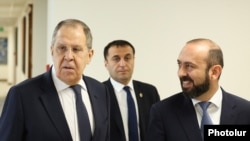
“Such a policy is not being pursued,” Mirzoyan told Armenian Public Television. “This is also made clear to our international partners so that there is no misunderstanding. We are deepening relations, building them with various geopolitical centers so that they understand our expectations correctly.”
Tensions between Moscow and Yerevan have steadily grown in recent years, with Prime Minister Nikol Pashinian seeking to reorient his country towards the West and the European Union in particular. Pashinian’s government underlined that dramatic foreign policy change in April 2025 when it enacted a law calling for the “start of a process of Armenia's accession to the European Union.”
Moscow deplored the move, calling it “the beginning of Armenia's withdrawal” from the Eurasian Economic Union (EEU). Russian officials have repeatedly warned that Armenia risks losing its tariff-free access to Russia’s vast market and having to pay much more for Russian natural gas and foodstuffs.
Yerevan maintains that it does not intend to leave the EEU. Still, Pashinian stated this summer that Armenia will eventually have to choose between the EU and the Russian-led trade bloc. Russia accounted for over 35 percent of Armenia’s foreign trade in the first half of this year, compared with the EU’s 12 percent share.
“Breaking ties with Russia should not be identified with membership in the EEU,” said Mirzoyan. “We are now an EEU member state, and we now have beneficial cooperation within the EEU. If one day the question of joining the European Union arises, we will all sit down and think about it in parallel with that question.”