




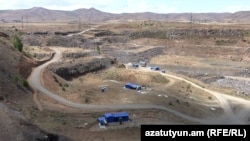
Work on the Kaps reservoir on the Akhurian river had begun in Soviet times but stopped after the catastrophic 1988 earthquake that devastated many surrounding communities and the provincial capital Gyumri. Armenia’s former government decided to revive and complete the project. Germany’s state-run development bank KfW agreed to lend it 50 million euros ($59 million) for that purpose in 2014.
KfW increased its low-interest funding to 68.5 million euros after the current government pledged to co-finance the project with 26.7 million euros of its own money. Prime Minister Nikol Pashinian’s cabinet also decided in August 2020 to spend 5 billion drams ($13 million) on relocating residents of a local village that would be partly submerged by the Kaps reservoir.
A Chinese company, Shanxi Construction Investment Group, subsequently won a contract to build the reservoir and adjacent irrigation facilities by April 2026. The reservoir was supposed to be expanded significantly in the future as part of a second phase of the project designed to improve supplies of irrigation water to many farmers in Shirak.
It was already obvious this summer that the implementation of its first phase has fallen well behind schedule. Shanxi has carried out less than 15 percent of the planned work to date, according to the Territorial Development Fund, an Armenian government agency dealing with the Kaps project.
The construction ground to a halt early this week following the departure of the Chinese workers who were based at the site. The reasons for their withdrawal or the serious lack of progress in the project’s implementation are not yet clear.
Pashinian announced on Thursday that the government has rescinded the contract signed with Shanxi. He accused the Chinese company of not honoring its contractual obligations. He also said that his government is not responsible for the disruption of the project.
“Major capital projects are like that,” Pashinian told reporters. “In all countries of the world, there are cases when projects are not implemented on time. We must note that this is one of those cases.”

Artak Kyurmian, a public policy expert, dismissed that explanation, saying that the government is trying to cover up its incompetence.
“There is always someone to blame but not the Armenian government, which continuously and consistently fails in this or that work that is important for the development of the Armenian economy,” Kyurumian told RFE/RL’s Armenian Service.
Pashinian promised on Thursday that the Kaps reservoir will eventually be constructed. But he declined to give any times frames for that. It is unclear whether his government plans to hire another contractor anytime soon.
Minister of Territorial Administration and Infrastructures Davit Khudatian is understood to have discussed the matter with senior KfW executives by phone on December 11. His office gave no details of the call.
A lack of irrigation water has long been one of the main problems facing Armenia’s agriculture sector. Environmental experts believe that ongoing global change can only aggravate the problem. The current government had committed itself to constructing 17 reservoirs across the country from 2021-2026.
Only one of those reservoirs has been built to date at a cost of roughly $105 million. The facility located near Vedi, a small town in the southern Ararat province, was inaugurated in May this year. Its construction, initiated by the country’s former government, began in 2017 and was mostly financed from a French government loan. The Vedi reservoir is due to provide irrigation water to thousands of farmers in the fruit-growing area south of Yerevan.