


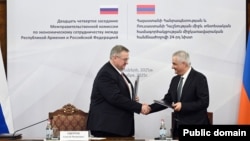
In a statement, the Armenian government said the commission co-headed by Overchuk and his Armenian counterpart Mher Grigorian looked into the “entire scope of trade, economic, cultural and humanitarian relations” between the two countries and “defined further steps for the development of cooperation in bilateral and multilateral formats.” It gave no further details.
Grigorian’s office could not be reached for comment. The Russian side released an identical readout of the meeting. Neither vice-premier made public statements right after it.
Overchuk told reporters on December 11 that Russian-Armenian trade is on course to shrink by half, to roughly $6 billion, this year. He said Russian companies are becoming “wary of working with Armenia” amid lingering tensions between Moscow and Yerevan.
Analysts believe that the main reason for the sharp fall in bilateral trade is that Armenia has stopped being a conduit for large-scale exports of Russian gold and diamonds to world markets. Russia is still Armenia’s most important trading partner, having accounted for over 35 percent of its commercial exchange with the outside world in the first half of this year, compared with the European Union’s 12 percent share. The South Caucasus state is part of the Eurasian Economic Union (EEU) that gives it tariff-free access to the vast Russian market.
“We believe that simultaneous membership in the two integration associations is incompatible,” said Overchuk. “At some point, the people of Armenia will have to make a choice.”
Overchuk issued a similar warning after his previous trip to Yerevan in August. That did not stop Prime Minister Nikol Pashinian from publicly pledging in September to step up “efforts aimed at Armenia's accession to the European Union.”