



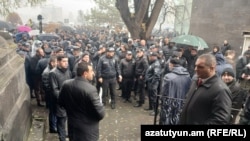
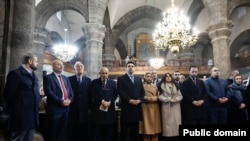
Pashinian attended it along with scores of his political allies and government and law-enforcement officials.
Pashinian has made a point of attending weekly liturgies in different churches in recent weeks in a bid to step up the pressure on the supreme head of the Armenian Apostolic Church. Parish priests that presided over those services deliberately failed to mention to Garegin in their prayers and sermons, breaching a centuries-old rule. Two of them have already been defrocked by the church’s Mother See in Echmiadzin as a result.
Stoking opposition accusations of abuse of power, Pashinian admitted last week that the National Security Service (NSS), the former Armenian branch of the Soviet KGB secret police, has been trying to have liturgies censored this way.
In a joint statement issued on Saturday, all 29 priests of the Shirak Diocese of the church comprising Gyumri reaffirmed their allegiance to Garegin, saying that they will not bow to government demands to avoid any public reference to him. They denounced the impending “seizure” of the city’s Holy Mother of God Cathedral, also known as the Church of the Seven Wounds.
“The Seven Wounds has survived two Turkish occupations and will survive this as well,” read the statement.
One of the signatories, Farther Nshan Panfyorov, said afterwards that unnamed security officials told him and the other clerics serving at the cathedral to hand in its keys. He said they refused while deciding to seal the church’s doors with paper and leave it on Saturday night.

Officials opened the doors the following morning ahead of the mass led by another priest brought in from another region of Armenia. Predicably, the latter failed to mention Garegin or the jailed primate of the Shirak Diocese, Archbishop Mikael Ajapahian, during the ensuing service held amid unusually heavy police presence in and around the church located at the main square of Armenia’s second largest city.
Several believers chanted Garegin’s name during the service. At least two of them were forcibly removed from the 19th century church moments later. A number of other citizens were unable to enter the church guarded by many unformed police and plainclothes officers.
Meanwhile, the Gyumri clergy held a Sunday mass at a larger church close to the Seven Wounds. It was packed with hundreds of local residents.
“A liturgy performed by brute force is not a liturgy,” Panfyorov told reporters after Pashinian and his entourage left the Seven Wounds.
Parliament speaker Alen Simonian, one of the officials accompanying Pashinian in Gyumri, denied that the local cathedral was seized by the authorities in breach of the Armenian constitution guaranteeing the church’s separation from the state. He reiterated government demands for Garegin’s resignation that have been backed by a dozen bishops and archbishops. Four of those clergymen were also present at the Gyumri service attended by Pashinian.
The Catholicos again rejected those demands late on Saturday as he was greeted by hundreds of supporters at Yerevan’s Zvartnots airport on his return from a visit to Switzerland and France. He also decried “baseless and trump-up accusations” levelled against Archbishop Arshak Khachatrian last week.
Khachatrian, who heads the church’s Mother See Chancellery, is the fourth senior clergyman loyal to Garegin and critical of Pashinian arrested in nearly six months.
Citing the latest arrest and other “repressions against clergy,” the Mother See announced later on Sunday the postponement of an emergency conference of bishops scheduled for December 10-12. The gathering was due to “examine the latest developments surrounding the Armenian Apostolic Holy Church.”
The ancient church, to which the vast majority of Armenians belong, has at least 55 bishops and archbishops around the world. In a statement issued on December 3, 27 of them condemned the 11 other bishops’ government-backed revolt against Garegin.
The number two figure in the church hierarchy, the Lebanon-based Catholicos Aram I, on Monday similarly denounced the Armenian government’s “unconstitutional and unacceptable” campaign, saying that it could “lead not only the church but also the nation and the country to self-destruction.”