


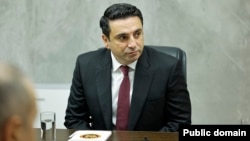
Speaking to journalists on the sidelines of an international conference in Yerevan, Simonian said the December trip will not be to the Azerbaijani capital.
“My visit to Azerbaijan, though not to Baku, is planned for next month,” Simonian told reporters, without giving an exact date or location.
Hikmet Hajiyev, a top foreign policy adviser to Azerbaijani President Ilham Aliyev, visited Armenia in June, meeting in the northern resort town of Dilijan with his then-Armenian counterpart, Armen Grigorian, Simonian’s predecessor, to discuss the bilateral peace agenda.
“Now I am set to pay a return visit,” Simonian said.
Simonian, who took over as Security Council secretary in August, already met with Hajiyev on the sidelines of a Shanghai Cooperation Organization summit in Bishkek, Kyrgyzstan, in September, following talks between Armenian Prime Minister Nikol Pashinian and Aliyev, as well as on the sidelines of a European Political Community summit in Dublin, Ireland, earlier this month.
The two South Caucasus neighbors have fought two major wars over Nagorno-Karabakh since the collapse of the Soviet Union, most recently in 2020, before Baku retook full control of the region in a September 2023 military offensive, prompting its entire ethnic Armenian population to flee to Armenia.
Normalization efforts have since gained momentum, buoyed by a U.S.-brokered peace summit in Washington in August 2025, though a final peace treaty has yet to be signed.
Simonian made the announcement while attending an international conference in Yerevan dedicated to the issue of persons missing from the decades-long conflict. Organized by the International Committee of the Red Cross delegation in Armenia and Armenian state bodies, the event brought together politicians, experts, human rights activists, as well as relatives of the missing.
During a news briefing held on the margins of the event, Simonian revealed that Baku has submitted a working draft proposal regarding missing persons, adding that Yerevan will also present its vision and initiatives in the near future. He noted that information regarding those who went missing during the first Karabakh war in the early 1990s remains particularly fragmented.
Addressing the conference, Simonian emphasized that Armenia has taken steps in recent years to identify missing individuals. “Peace becomes stronger when it is accompanied by resolving pain and building trust toward the future. Armenia is ready to continue efforts in that direction,” he said.
Prime Minister Pashinian, who also addressed the gathering, stressed that clarifying the fate of the missing is impossible without international cooperation.
“The most difficult part is that there are no answers to questions, and the task is to find them,” Pashinian said. “The Armenian authorities have never ceased their efforts to find answers to numerous questions.”
Foreign Minister Ararat Mirzoyan echoed those remarks, stating that “no one is forgotten” and underscoring that cooperation with Azerbaijan is essential for effective action.
Despite official assurances, relatives of missing persons have regularly staged protests in Armenia, demanding more decisive government action to determine the fate of their loved ones.
According to Armenian data, more than 1,000 Armenians remain missing from the two Karabakh wars, while Azerbaijan puts the number of its missing citizens at around 4,000.
In an X post Hajiyev wrote on Thursday that Azerbaijan expects Armenia to publish information regarding the locations of more than 200 mass graves.
The senior Azerbaijani official said the exchange of information will be “an important step toward strengthening trust, ensuring transitional justice, and establishing lasting peace in the region.”
“Families deserve to know the fate of their loved ones,” he noted.