




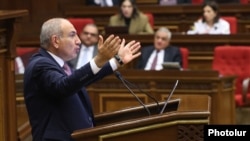
Speaking during a heated question-and-answer session in the National Assembly, Pashinian unveiled what he earlier described as a “proposal to the opposition it can’t reject” challenging the two opposition blocs to back the referendum bill in exchange for his departure from office.
“You say you want to remove me. Very well. We go to a referendum, and in both outcomes I leave,” Pashinian told lawmakers. “If the people do not vote for the new constitution, I leave. If the people vote for the new constitution, I go and sign the peace treaty [with Azerbaijan], we ratify it, that is, several points of the peace agenda are implemented, and I leave.”
“Do you want to remove me? Very well. This is my offer to you. Remove me. Prove that you want to remove me,” he added.
Pashinian warned that if opposition deputies block the government’s push for a constitutional referendum, he would trigger a process leading to snap parliamentary elections in which, he claimed, the current opposition factions would not be reelected.
“Now the formula is complete: either you remove me, or I remove you,” he told lawmakers from the Strong Armenia and Hayastan alliances.
Opposition lawmakers swiftly rebuffed the proposal, accusing the prime minister of untrustworthiness and of seeking to rewrite Armenia’s basic law at the behest of neighboring Azerbaijan.
Anna Grigorian, the head of the Hayastan faction, dismissed Pashinian’s pledge to step down as a ploy and flatly rejected the deal over what opposition groups have dubbed “Aliyev’s Constitution” in reference to Azerbaijani President Ilham Aliyev.
“Mr. Pashinian, you have no credibility with at least 50 percent of our people. Do you think we are so naive as to believe that you would voluntarily leave your post under any circumstance? Not only do we distrust you, we much more so distrust Aliyev,” Grigorian said.
“Aliyev’s Constitution will not pass in Armenia,” she added. “Do whatever you want, beat your chest like King Kong, send law enforcement officers into our homes. Our answer is no, nyet, nein. I don’t speak Turkish, or else I would say no in Turkish as well.”
Kristine Vardanian, another lawmaker from former President Robert Kocharian’s Hayastan bloc, echoed that stance, stating that the opposition intends to oust Pashinian “without striking a deal” with him. “The problem is that we do not trust either you or Aliyev. You have not left any room for trusting you,” Vardanian said.
Narek Karapetian, the parliamentary leader of the Strong Armenia alliance, also effectively rejected Pashinian’s offer. He questioned Pashinian’s ability to control the political situation, accusing him of acting on instructions from Baku.
“The problem is in the one who tells you what to do,” Karapetian said, referring to Aliyev. “We want you to convey to him, your educated and constructive partner, that he will not govern here. He cannot govern in Armenia.”
“Armenians will not [change the constitution] at Aliyev’s behest. It is the foundation of our sovereignty,” Karapetian added.
Pashinian’s challenge stems from a procedural hurdle created by the June 7 parliamentary elections. While Pashinian’s ruling Civil Contract party won a majority in the 105-seat National Assembly, it fell short of the two-thirds constitutional majority, which is at least 70 votes, required to send a draft constitution to a national referendum.
Civil Contract holds 64 seats in parliament and needs the backing of at least six opposition deputies to pass the referendum measure.
Opposition lawmakers argued on Wednesday that Civil Contract lacks a popular mandate to overhaul the constitution because voters denied the ruling party a two-thirds majority in the June elections despite Pashinian’s campaign warnings that failure to grant it could lead to a “catastrophic war.”
Prior to making his resignation offer, Pashinian vowed he would not back down and would “bulldoze” his way toward holding the referendum if necessary.
Baku has repeatedly called for changes in the Armenian constitution as a precondition for signing a bilateral peace treaty. Azerbaijan objects to the preamble of Armenia’s current constitution, which references the 1990 Declaration of Independence. That founding document cites a 1989 unification act adopted by Soviet Armenia and the then-Nagorno-Karabakh Autonomous Oblast inside Soviet Azerbaijan – a provision that Baku views as an implicit territorial claim and wants to be removed from Armenia’s constitution.
Although the government has not yet published the draft of the new constitution, which is expected to be unveiled within days, Armenian officials have indicated it will omit any mention of the 1990 declaration.
Armenia and Azerbaijan fought two major wars over Nagorno-Karabakh following the collapse of the Soviet Union, a decades-long conflict that effectively ended in September 2023 when Azerbaijani forces recaptured the ethnic Armenian-populated region in a lightning offensive, prompting the exodus of more than 100,000 ethnic Armenians.
While Yerevan and Baku initialed a peace agreement during U.S.-brokered talks in Washington in 2025, Azerbaijan insists the treaty cannot be signed until Armenia removes the constitutional reference.
Addressing parliament, Pashinian framed the proposed constitution as a choice between “a viable, peaceful state and perpetual regional conflict,” arguing that an “overwhelming majority” of Armenians would approve it.
“The message of the new constitution is one: we are closing the chapter of conflicts in all directions and making peace irreversible,” Pashinian said, contrasting his vision of a “Real Armenia” with what he described as an opposition-backed concept of constantly pursuing “other Armenias” outside the nation’s internationally recognized borders.
Opposition parties, including Strong Armenia, Hayastan, and 10 extra-parliamentary political groups that recently pledged to mobilize public pressure against the initiative, maintain that removing the reference to the Declaration of Independence would erode the foundations of Armenian statehood and invite further unilateral demands from Baku.