


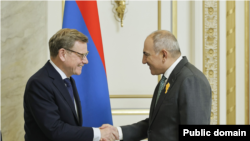
According to the Armenian Prime Minister’s Office, Wadephul expressed confidence that the “emerging constructive atmosphere” in the region will foster regional connectivity and cooperation.
Pashinian, for his part, highlighted Germany’s backing for his government’s democratic reform agenda and the development of Armenia-EU relations. Describing Germany as one of Armenia’s key partners within the bloc, the prime minister noted that “high-level political dialogue between the two countries remains dynamic and regular.”
During the meeting, the two officials reportedly discussed regional developments, trade and economic ties between Armenia and the EU, and Yerevan’s ongoing efforts to diversify its economy. Wadephul and Pashinian also explored ways to expand bilateral relations across multiple sectors, placing particular emphasis on developing cooperation in green energy, the Armenian Prime Minister’s Office said.
Wadephul arrived in the Armenian capital from Baku, where he met with Azerbaijani President Ilham Aliyev and Foreign Minister Jeyhun Bayramov as part of his first official tour of the South Caucasus.
Speaking at a joint news conference in Baku ahead of his trip to Yerevan, Wadephul stated that Armenian-Azerbaijani normalization would be the primary focus of his visit to Armenia.
Before departing for the region on November 17, Wadephul issued a pointed warning to Moscow against interfering in efforts by Armenia and Azerbaijan to forge closer ties with Europe.
Criticizing Russian policies in the South Caucasus and citing Moscow’s ongoing war against Ukraine, the German diplomat said that “decisions about closer ties between Russia’s neighbors and Europe should not be made in Moscow” and urged that both countries be allowed to shape their futures independently.
The German minister’s regional visit follows a U.S.-brokered framework in August 2025 in which Pashinian and Aliyev initialed a peace agreement aimed at ending decades of hostilities over the Nagorno-Karabakh region.
Ahead of his talks in Baku and Yerevan, Wadephul described the current moment as a “historic opportunity” for the South Caucasus and pledged that Germany would act as a reliable partner in supporting de-escalation and open borders.