


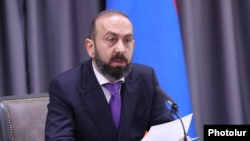
Mirzoyan described as politically motivated a joint report by their governments effectively recommending the membership suspension.
The report posted on the Russian government’s website on October 20 says that that Russia, Belarus, Kazakhstan and Kyrgyzstan “have the right to consider” such a measure because of a 2025 Armenian law that declares the start of a “process” of Armenia’s accession to the European Union. The law runs counter to the EEU’s founding treaty and other rules, it says.
“The Republic of Armenia has not violated any obligations within the framework of the EEU, nor does it intend to do so,” Mirzoyan said after talks in Yerevan with Dutch Foreign Minister Tom Berendsen.
“There is a political motive here -- we all understand that -- and perhaps even a political directive for lawyers to find some legal justification,” he told a joint news conference.
Prime Minister Nikol Pashinian went farther when he reacted to the report on October 22, saying that it is part of Russia’s efforts to depose him.
Moscow has been pressuring Yerevan to quickly choose between continuing to seek EU membership and remaining part of the ex-Soviet bloc essential for the Armenian economy. Russian President Vladimir Putin as well as the leaders of Belarus, Kazakhstan and Kyrgyzstan called for an Armenian referendum on the issue during a summit in May.
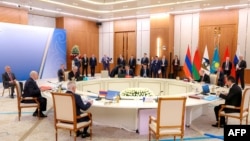
They also instructed their prime ministers to detail “possible consequences” of Armenia’s membership suspension before their next summit planned for December. The resulting report says that a loss of tariff-free access to the Russian market and a sharp rise in the price of Russian natural gas imported by the South Caucasus country would cause the Armenian economy to shrink by over 15 percent.
Armenian Economy Minister Gevorg Papoyan dismissed that scenario as “exaggerated” on October 21. Pashinian likewise said that the Armenian economy is resilient enough to cope with them.
“Regardless of what happens, at the core of our decisions and conduct lie Armenia’s statehood, sovereignty and independence, including the right to make independent decisions, which we will not turn into a subject for bargaining,” Mirzoyan said for his part.
Armenia’s main opposition groups see Pashinian’s pro-Western foreign policy as reckless, saying that he is needlessly antagonizing Russia without having a real prospect for EU membership in the foreseeable future.
Russia remained Armenia’s principal export market even after blocking imports of Armenian agricultural products and mineral water earlier this year. Armenia also buys the bulk of its natural gas from Russia at a significant discount.