


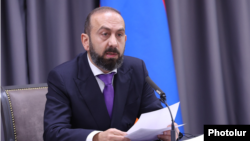
Mirzoyan addressed the Armenian parliament committee on defense and security before it formally recommended the parliamentary ratification of a U.S.-Armenian agreement on the Trump Route for International Peace and Prosperity (TRIPP) that would connect Azerbaijan to its Nakhichevan exclave and Turkey.
The agreement signed in June calls for the creation of a joint venture that will manage for at least 49 years a railway, a road, energy supply lines and other infrastructure to be built along the corridor. The U.S. government will own 74 percent of the TRIPP Development Company (TDC) that will receive “exclusive land use rights, development rights, related permissions, and all other rights.”
While upholding Armenia’s “full sovereignty and jurisdiction over its borders and customs operations,” the deal commits the Armenian government to the so-called “front office/back office” model whereby a private operator hired by the TDC will provide “customer-facing services” at the border crossings with Azerbaijan. Mirzoyan said that the operator may well have a security service.
“Any company -- especially large infrastructure companies -- may have its own security divisions, but these must be licensed and authorized within the Republic of Armenia, as is already the case today for many private companies,” the told members of the parliament committee mostly affiliated with the ruling Civil Contract party.
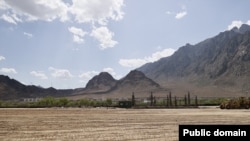
Armenian officials are to be given be a “back office” role at the TRIPP. Mirzoyan insisted that this will not undermine Armenian sovereignty over the strategic area bordering Iran. Opposition lawmakers remained unconvinced by his assurances.
Azerbaijani President Ilham Aliyev has said that Azerbaijanis travelling to from Nakhichevan “should not see the faces of Armenian border guards.” Artur Khachatrian, a lawmaker representing the opposition Hayastan alliance, said that the “front office/back office” model is designed to satisfy this demand.
“This is yet another demand for us to cede our sovereignty,” Khachatrian told RFE/RL’s Armenian Service. “Just imagine: you land at the Baku airport and say, ‘You know what? I don't want to see this Azerbaijani officer; bring me, for example, a Filipino instead.”
The Strong Armenia alliance, a larger opposition group represented in the parliament, likewise claimed on Wednesday that the TRIPP project “serves the interests of Azerbaijan, not Armenia.”
“Such concessions will not bring peace; they will only lead to further aggression by Azerbaijan,” it said in a statement.
Neighboring Iran has also voiced serious concerns over the TRIPP. In particular, it fears that the transit arrangement could lead to U.S. military or security presence along the Armenian-Iranian border.
Mirzoyan and other Armenian officials have ruled out such presence. Visiting Yerevan last week, Iranian Foreign Minister Abbas Araghchi said that the Armenian government is addressing Tehran’s concerns.