



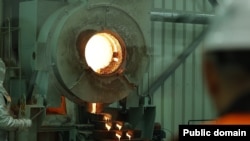
Pashinian described the development of the Amulsar gold deposit in the southeastern Vayots Dzor province as a “success story” that will contribute to the country’s economic development.
A U.S.-Canadian company now called Lydian Canada Ventures had planned to start open-pit mining operations and annually produce 210,000 ounces of gold, worth $880 million at current international prices, there in late 2018, more than two years after obtaining the necessary licenses from Armenia’s former government. However, the planned operations were disrupted after several dozen environmental protesters blocked all roads leading to Amulsar following the “velvet revolution” of April-May 2018 that brought Pashinian to power.
The protesters said that the project would wreak havoc on the environment. Lydian denied that, saying it would use modern technology to prevent such damage.
The current Armenian government did not revoke Lydian’s mining licenses. But it refrained from using force to end the blockade, effectively siding with the protesters. Lydian claimed to have invested $460 million by that time.
Following the disastrous 2020 war in Nagorno-Karabakh, the government began negotiating with Lydian to revive one of the biggest ever foreign investment projects in Armenia’s history. In 2023, two U.S. and Canadian equity firms that currently own Lydian agreed to give the government a 12.5 percent stake in the Amulsar operation. In February 2025, Pashinian’s government guaranteed the repayment of $150 million in loans obtained by them from Armenian banks for finishing the construction of production facilities at Amulsar.
Lydian has pledged to create at least 700 permanent jobs there. It is also expected to pay around $130 million in taxes annually. Government officials estimate that this will add at least 1.5 percentage points to Armenia’s annual growth rate.
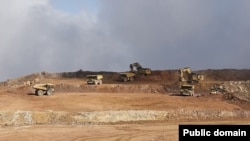
“The fate of this investment project will be of great significance for attracting similar new investment projects,” Pashinian said in a speech at the inauguration ceremony. “I believe that in this regard we can state that we have achieved success.”
Critics say that Pashinian’s administration has on the contrary scared away foreign investors by preventing the opening of the mine as planned in 2018. They argue that Lydian could not attract further investments in the West and had to borrow the money in Armenia with government guarantees. The government was earlier taken to international court by some of Lydian’s current or former American shareholders.
The company’s renewed operations sparked no major protests, a fact emphasized by Pashinian. The latter declared that all concerns over the environmental impact of gold mining at Amulsar have been addressed by the mine’s operator.
“We must also acknowledge that for any developed country, mining of this quality -- responsible in both environmental and social terms -- serves as a crucial engine of national development,” he said.
“We have a world-class mine, explored, developed, and constructed in accordance with the highest international standards, while adhering to environmental protection, occupational safety, and international best practices,” Hayk Aloyan, Lydian’s top executive in Armenia, said for his part.