


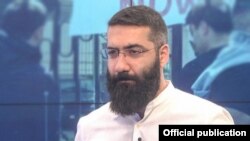
Artur Danielian, a nationalist activist critical of the Armenian government, was taken into custody on Tuesday just hours after he furiously condemned Pashinian for indicating that Yerevan will not try to exchange an Azerbaijani soldier captured last week for Armenian prisoners held in Azerbaijan. Danielian branded Pashinian a “scum” in a Facebook post.
He was initially charged with “hooliganism.” According to Danielian’s lawyer Tigran Atanesian, Armenia’s Investigative Committee also accused him of discrediting another law-enforcement agency, the National Security Service (NSS), before a court in Yerevan sanctioned his pretrial arrest on Wednesday night. The committee did not release any details of the criminal case as of Thursday afternoon.
In his post, Danielian alleged that the Azerbaijani serviceman, Nasimi Musayev, crossed into Armenia last year together with two other members of a “sabotage group” who managed to return to Azerbaijan. Pashinian has dismissed such claims as “nonsense,” saying that Musayev deserted his military unit or entered Armenia by accident. The premier fired on Monday a deputy head of the NSS overseeing Armenian border guards deployed along some sections of the Armenian-Azerbaijani border.
Danielian is a former member of Armenia’s ruling Civil Contract who left it before the 2018 “velvet revolution” that brought Pashinian to power. He leads a fringe opposition party called Adekvat.
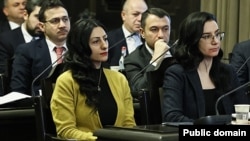
Armenian prosecutors did not deny last November reports that they are monitoring people posting angry comments about Pashinian and other state officials and have ordered criminal investigations into some of them. About a dozen of them are known to have been prosecuted since then.
They include Vahram Sahakian, an outspoken writer and playwright. Sahakian was arrested on September 29 on charges of inciting “hatred, intolerance and hostility” in a Facebook post in January 2025. A Yerevan court freed Sahakian the next day. But it banned him from making social media posts pending investigation.
Artur Papian, the chairman of the Yerevan Press Club, expressed on Thursday serious concern at the continuing crackdown, accusing the Armenian authorities of a “coordinated effort to intimidate the public and silence dissent.” He also decried the fact that “overt threats and hate speech directed at oppositionists go completely unpunished.”
“Human rights organizations, civil society, and international bodies must provide a clear and unequivocal assessment of these encroachments,” wrote Papian. “If we acquiesce to such precedents today, tomorrow any citizen's Facebook opinion could turn into a criminal case.”
No Pashinian supporters have been prosecuted for offending or threatening opposition politicians. Pashinian himself has regularly insulted them. Campaigning for the June 7 parliamentary elections, he pledged to “take out” his main political foes. Law-enforcement authorities refused to investigate that statement.

Armenia’s former government decriminalized all forms of slander and defamation in 2010, drawing praise from Western governments and human rights bodies. The current government, which enjoys the strong backing of the European Union and the United States, made “grave insults” directed at state officials and public figures a criminal offense in 2021. It repealed the measure under domestic and foreign pressure a year later.
Critics say the authorities have effectively criminalized libel offenses again by characterizing them as “hooliganism” and “hate speech.” They also accuse Pashinian’s administration of introducing Soviet-style restrictions on public criticism of law-enforcement bodies and courts.
As recently as on October 1, an Armenian opposition parliamentarian, Edgar Ghazarian, received a suspended two-year prison sentence for strongly criticizing a Constitutional Court ruling handed down two years ago. A Yerevan court convicted him of spreading “defamatory information” about its justices. Ghazarian will lose his parliament if the ruling, denounced by him as politically motivated, is upheld by appeals courts.