




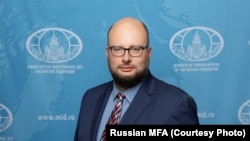
“We have an extensive legal framework with Armenia that enshrines the privileged, allied status of our bilateral relations,” Mikhail Kalugin, a senior Russian Foreign Ministry official, told the RIA Novosti news agency. “If the Armenian authorities wish to revise this status as part of a ‘diversification’ of their foreign policy, that is their right. However, they would then also have to forgo the preferences that Moscow grants exclusively to its allies. The price of gas is one example of such preferences.”
Kalugin issued the warning five days after Prime Minister Nikol Pashinian said that the Armenian government has received no “signals” from the Russian side about an impending rise in the gas price. The government is therefore not yet making any contingency plans for such a scenario, he told journalists.
Armenia imports from Russia the bulk of natural gas used by its power plants, households and some sectors of the domestic economy, paying the Gazprom monopoly $177.5 per thousand cubic meters of the fuel. By comparison, the market-based gas price in the European Union currently stands at roughly $875 per thousand cubic meters.
Moscow first officially threatened to end this discount with a letter sent to Yerevan by Russian Energy Minister Sergei Tsivilev in May. It came as Russian authorities began banning imports of Armenian agricultural products and pressuring Yerevan to quickly choose between seeking to join the European Union and remaining part of a Russian-led trade bloc.
Pashinian ruled out any reversal of his pro-Western foreign policy after winning disputed parliamentary elections held in June. In a five-year policy program adopted in August, his government did not characterize Russian-Armenian relations even as “strategic partnership.”
Pashinian downplayed the Russian threats on September 11, saying that his administration will “diversify” gas imports, whatever their cost. The secretary of Armenia’s Security Council, Alen Simonian, said afterwards that it is planning to buy gas “from all possible places,” including Azerbaijan, Iran and even Turkey.
Alexei Shevtsov, the deputy secretary of Russia’s Security Council, dismissed those statements on September 25, insisting that Armenia has no viable alternatives to the cheap Russian gas. Kalugin made the same point.
“It is obvious that Yerevan will not find terms as favorable as those currently offered by Russia anywhere else,” said the Russian diplomat.
The governor of the Armenian Central Bank, Martin Galstian, acknowledged on September 15 that the price hike threatened by the Russians would have severe economic consequences for the country.