




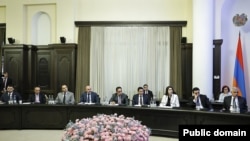
The draft 2027 state budget approved during a weekly cabinet meeting in Yerevan calls for over 4 trillion drams ($11 billion) in total expenditures.
That includes 616.5 billion drams ($1.7 billion) in defense spending which would rise by about 9 percent. Prime Minister Nikol Pashinian’s government controversially cut it by 15 percent last year.
The Armenian Interior Ministry comprising the national police service is set for a much sharper rise in government funding. It will soar by 40 percent to 145 billion drams if the proposed budget is approved by the Armenian parliament.
The Ministry of Labor and Social Affairs will remain the largest recipient of public funds. The draft budget allocates 1.1 trillion drams to pensions and other social programs overseen by it, compared with 440 billion drams earmarked for education, science and culture and 350 billion drams for healthcare.
The government is also planning a nearly 19 percent surge in spending on the salaries of senior state officials and public sector employees. Under a separate bill approved by it on September 17, it will roughly double the salaries of Pashinian, members of his cabinet, other government officials and parliament deputies in addition to hefty bonuses regularly paid to them.
Despite the sizable increase in public spending, the government is committing itself to cutting the budget deficit both in absolute terms and as a share of GDP. It will have to boost state revenue by 14 percent, to 3.6 trillion drams, for that purpose.
The budgetary targets are based on the assumption that the Armenian economy will grow by 5.8 percent in 2027, slightly faster than is expected this year. The growth target is in turn tied to more capital projects financed by the government and the planned opening of a new gold mine in Armenia.
The government does not seem worried about the impact of further economic sanctions against Armenia that have been threatened by Russia in response to Pashinian’s pro-Western foreign policy. They include a sharp rise in the price of Russian natural gas imported by the country. The governor of the Armenian Central Bank, Martin Galstian, acknowledged on September 15 that it would have severe economic consequences.