


“Not only our contacts with Russia are important, but also our possibilities within the EEU,” Gasparian told reporters, saying Armenia was actively using EEU mechanisms to remove what he described as trade barriers.
Asked whether Russia’s claims of violations by Armenian exporters were entirely unfounded, Gasparian said the restrictions, in Armenia’s view, do not comply with the agreements and principles governing the EEU.
“We are trying to use EEU tools to restore principles,” he said.
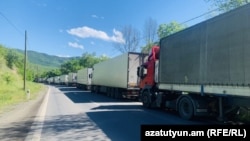
Russia began imposing restrictions in May on imports of various Armenian goods, including agricultural produce, fish products, beverages, dairy products and cut flowers. The restrictions came amid Armenia’s growing economic and political ties with the West, particularly the European Union.
They followed two European summits held in Yerevan, during which Prime Minister Nikol Pashinian reaffirmed his government’s intention to seek Armenia’s eventual EU membership.
During a visit to Yerevan in early July, European Commission President Ursula von der Leyen said the EU would open its highly regulated market to Armenian agricultural products.
Moscow has said Armenia’s aspirations to deepen ties with the EU are incompatible with its membership in the EEU, which also includes Belarus, Kazakhstan and Kyrgyzstan.
At a September 1 meeting with Pashinian in Bishkek, Kyrgyzstan, Russian President Vladimir Putin again called for a referendum in Armenia on whether the country should remain in the EEU or seek EU membership.
Pashinian has repeatedly rejected Moscow’s calls for such a referendum, saying that while Armenia seeks to diversify its political and trade relations, including with Brussels, it sees no urgent need for a formal vote at this stage. He told Putin in Bishkek that the issue was “not yet mature enough” to be put to a referendum.
The Armenian government has described the Russian trade restrictions as unreasonable and contrary to EEU rules. Pashinian has repeatedly urged Armenian businesses to use the restrictions as an opportunity to diversify their export markets.
Gasparian stressed that, as a full member of the EEU, Armenia expects all of the bloc’s mechanisms to function properly.
At the same time, he said Armenia needs to open new markets to ensure the long-term stability of its economy.
Gasparian said Armenian goods exported to international markets should meet high quality and production standards and have higher added value, arguing that economic growth should be based on more intensive development.
Despite subsidies offered by the Armenian government to farmers and agribusiness firms to encourage exports to new markets, official data released late last month showed that Armenia’s exports continued to fall significantly in July, declining by about 16 percent year on year.
Still, Gasparian defended the government’s policy of export diversification, including efforts to increase exports to EU member states.
“I think the government’s diversification policy is a path toward long-term stability, and its results should be assessed over the long term,” the deputy minister said.