




The ruling, issued Monday, follows the successive refusal of three judges to proceed with the case after the trial formally began on August 7. The first judge cited concerns about impartiality, while the other two disputed which court had jurisdiction over the proceedings.
The case will now be heard by Armavir Judge Serzh Rushanian, who had previously transferred it to a Yerevan court, according to the Supreme Judicial Council.
The latest jurisdictional dispute was raised by Yerevan Judge Vahagn Melikian, who asked the Court of Cassation to determine which court should hear the case. Melikian had declined to proceed with the trial pending the ruling.
The Court of Cassation said the Armavir court had taken a “purely subjective and formal approach” in transferring the case to Yerevan, thereby creating “an unnecessary jurisdictional dispute” and “unnecessary judicial circulation.” It said this could jeopardize the defendants’ “constitutionally and conventionally guaranteed right to have their case examined within a reasonable time.”
Rushanian was the second Armavir judge assigned to the case to decline to proceed with it. He said he was not seeking to avoid hearing the case but believed it should be tried in the place where the alleged offense was committed, prompting its transfer to Yerevan.
The first judge assigned to the case, Hakob Manukian, recused himself, citing concerns about his impartiality. He said he had been awarded his lawyer’s license by one of Garegin’s defense attorneys.
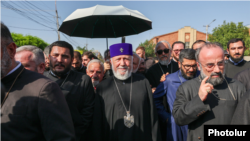
The accusations against Garegin stem from his January 27 decision to defrock a pro-government bishop involved in Prime Minister Nikol Pashinian’s controversial campaign to oust the Catholicos. The bishop, Gevorg Saroyan, had been dismissed earlier in January as head of a church diocese.
With Pashinian’s encouragement, Saroyan refused to obey the decision and challenged it in court. In an unprecedented injunction, a district court ruled that Saroyan must be reinstated pending its verdict on the lawsuit.
Garegin and the six other clergymen are accused of obstructing the execution of that court order. Their lawyers maintain that Armenian courts have no jurisdiction over internal church affairs. They, as well as Armenian opposition figures and other critics of the government, say the case is part of Pashinian’s campaign against Garegin.
No date has yet been announced for the resumption of the trial.