



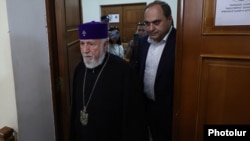
Khachatur Galstian, who has since moved to the bar, told RFE/RL’s Armenian Service on Monday that he submitted his resignation days before the trial began on August 7. He said he continues to believe that the evidence supporting the charges against Garegin is sufficient and well-founded.
“If I had disagreed with the decision to prosecute the Catholicos, I would not have signed the indictment,” Galstian said.
The Prosecutor-General’s Office has also stressed that Galstian left at his own request and that his departure was in no way connected with the case. Other prosecutors will now represent the prosecution in court.
Garegin’s lawyer, Armine Fanian, however, has not ruled out the possibility that Galstian disagreed with his superiors during the judicial phase of the case and decided not to continue working on it.
“It is one thing to sit in your office, reject motions by defense attorneys and appeal court decisions favorable to the defense, and another to defend that charge in court under conditions of public accountability,” Fanian said. “Very serious psychological strength is needed to come and defend the charges against the Catholicos of All Armenians and six senior clergymen.”
The case against Garegin and the six clergymen stems from the Catholicos’s decision to defrock Archbishop Gevorg Saroyan, the former head of the Masisotsn Diocese, after Saroyan joined a government campaign calling for Garegin’s resignation.
An Armenian court had ordered Saroyan’s reinstatement, but the Mother See of Holy Etchmiadzin did not restore him to his position and instead defrocked him. The Mother See argued that such matters did not fall within the courts’ jurisdiction and constituted interference in the church’s autonomy.
Three judges have declined, for different reasons, to proceed with the case since the trial began a month ago. None has explicitly linked their decision to disagreement with the prosecution’s case.
Garegin and the six senior clergymen have denied the charges, while their lawyers argue that Armenian courts and law-enforcement bodies have no authority over the internal affairs of the church.
If convicted, Garegin and the other clergymen on trial face up to two years in prison.
The case is unprecedented in independent Armenia, marking the first time the head of the Armenian Apostolic Church has faced trial.
The legal proceedings follow Prime Minister Nikol Pashinian’s prolonged campaign to remove Garegin from his post. Pashinian openly began challenging the legitimacy of the Catholicos in May 2025 by accusing him of violating his vow of celibacy. He and other members of his political team also began using the spiritual leader’s secular name, Ktrij Nersisian, to emphasize their non-recognition of his status.
Pashinian later added other accusations, including that Garegin was an agent of foreign influence and was inciting another war with Azerbaijan by having priests pray during church services for “the protection of Artsakh,” which is the Armenian name for Nagorno-Karabakh. The region had been disputed between Armenia and Azerbaijan for decades following the collapse of the Soviet Union before Baku militarily captured it in September 2023, forcing its entire ethnic Armenian population to flee to Armenia.
Pashinian has repeatedly stated, both before and after Yerevan and Baku inked a peace deal in August 2025 to end more than three decades of conflict, including two deadly wars, that the movement for the cessation of Nagorno-Karabakh from Azerbaijan, which began back in 1988, must not be continued in Armenia.