



Judge Vahagn Melikian, of a Yerevan court of general jurisdiction, has asked the country’s Court of Cassation to determine which court has jurisdiction over the case, it emerged on Thursday.
The Court of Cassation told RFE/RL’s Armenian Service that the judge based his appeal on part 4 of Article 263 of Armenia’s Criminal Procedure Code. Under that provision, a court that receives a case on jurisdictional grounds may challenge that jurisdiction before preliminary hearings are scheduled. The issue must then be resolved within five days by the chairman of the Criminal Chamber of the Court of Cassation.
The Court of Cassation will therefore determine whether the case should be heard by a court in Yerevan or in Armavir Province, from where it was transferred to Yerevan.
The move comes after two other judges in Armavir declined to proceed with the case.
The first judge, Hakob Manukian, recused himself, citing concerns about his impartiality. He said he had studied at the Academy of Advocacy in 2021, when Garegin’s defense lawyer, Ara Zohrabian, was chairman of the Armenian Chamber of Advocates and had personally awarded Manukian his lawyer’s license.
The second judge, Serzh Rushanian, said he was not seeking to avoid hearing the case but believed there was a jurisdictional problem. He argued that the case should be heard in the place where the alleged offense was committed. His decision resulted in the proceedings being transferred to a Yerevan court.
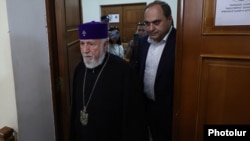
Garegin and six archbishops and bishops went on trial on August 7 on charges stemming from the defrocking in January this year of another, pro-government bishop involved in Pashinian’s controversial campaign to depose the Catholicos.
Their lawyers maintain that Armenian courts and law-enforcement bodies have no jurisdiction over internal church affairs. The Armenian Constitution guarantees the ancient church’s independence and separation from the state.
The case is unprecedented in independent Armenia, as it marks the first time the head of the Armenian Apostolic Church has faced trial.
If convicted, Garegin and the other senior clergymen could face up to two years in prison.
Pashinian began pressuring Garegin to resign in June 2025 shortly after the Catholicos accused Azerbaijan of committing ethnic cleansing in Nagorno-Karabakh and illegally occupying Armenian border areas during an international conference in Switzerland. Three Armenian archbishops and one bishop were arrested in the following months on different charges strongly denied by them. They all were moved to house arrest this year.
Pashinian repeatedly attacked Garegin and referred to him by his secular birth name, Ktrij Nersisian, while presenting his government’s five-year policy program to the Armenian parliament last month.
He also announced that the government would soon unveil a report on the “crisis” in the church before enacting, together with the ruling Civil Contract party, unspecified legal amendments relating to the church. Pashinian also said he was ready to meet Garegin to discuss his “reform agenda.”
“The Government has neither the authority nor the constitutionally established competence to make the reform of the Church part of its program or, at its own discretion, impose any ‘proposals’ or demands upon the clergy,” the church’s Supreme Spiritual Council countered in a statement issued on August 26.
The council headed by Garegin again rejected Pashinian’s “blatantly false accusations” and accused him of “openly violating the country’s Constitution and disregarding rights enshrined in international law.”
The two opposition factions represented in the Armenian parliament have strongly supported Garegin in the ongoing dispute.