


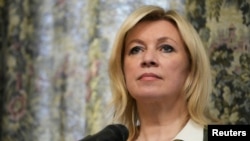
“Unfortunately, the negative trend that Russia’s President Vladimir Putin noted during his meeting with Armenian Prime Minister Nikol Pashinian in Moscow on April 1 continues to persist,” said Maria Zakharova, the Russian Foreign Ministry spokeswoman. “Namely, the escalation of real repressions against political forces and figures standing for the preservation of allied relations with Russia.”
“This destructive line taken by the Armenian authorities stands in stark contrast to official Yerevan's public assurances that it is not taking steps to worsen relations with Russia,” she told a news briefing.
“We expect that political parties and blocs, local government leaders, public figures and activists who are making efforts to strengthen traditional bilateral cooperation [with Russia] will be able to calmly participate in Armenia's domestic political life and contribute to its development and prosperity,” added Zakharova.
She spoke two days after the arrest of former Armenian President Robert Kocharian. His Hayastan alliance and two other opposition groups led by wealthy businessmen Samvel Karapetian and Gagik Tsarukian were Pashinian’s main challengers in parliamentary elections held on June 7. They all pledged to repair Armenia’s relationship with its traditional ally while being careful not to openly side with Moscow.
Pashinian vowed to “take out” their leaders during the election campaign, accusing them of being agents of a foreign state, presumably Russia. Karapetian was already jailed in June last year before being moved to house arrest in December. Tsarukian was arrested on July 6. All three opposition leaders deny separate criminal charges levelled against them.
Pashinian on Tuesday again claimed to have a popular mandate to jail them. His Civil Contract party won just under half of the vote in the elections, according to their official results rejected by the Armenian opposition as fraudulent.
Russia likewise described the polls as deeply flawed, with Putin pointedly declining to congratulate Pashinian on his reelection. Zakharova claimed that the June 7 polls demonstrated “the Armenian public's demand for the development of bilateral ties” with Russia.
The rare Russian criticism of internal political developments in Armenia highlights a further deterioration of Russian-Armenian relations that followed two European summits held in Yerevan in May. Moscow has since been pressuring Pashinian’s government to quickly choose between seeking to join the European Union and remaining part of a Russian-led trade bloc.
Pashinian raised the stakes on Monday when he pledged to formally apply “soon” for Armenia’s accession to the EU. Senior Russian lawmakers responded by warning of further economic sanctions against Yerevan. Moscow essentially banned multimillion-dollar imports of Armenian agricultural products and mineral water in late May and early June.