


The government pledged instead to bolster the country’s “strategic partnership” with the United States and continue seeking its eventual membership in the European Union.
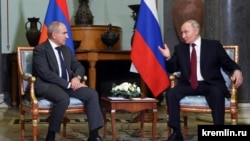
Its previous such program adopted in 2021 referred to the Russian-Armenian “strategic alliance” as a key element of Armenia’s national security doctrine. Prime Minister Nikol Pashinian and his cabinet now plan to continue a “dialogue” with Moscow aimed at “mutually beneficial multi-sectoral cooperation” and a “transformation” of bilateral ties.
The change of rhetoric highlights a significant deterioration of those ties. The process accelerated this spring, with Moscow banning key imports from Armenia and pressuring Yerevan to swiftly choose between remaining part of a Russian-led trade bloc and continuing its European integration drive.
Pashinian remains reluctant to make such a choice, mindful of the Armenian economy’s heavy dependence on Russia’s market and energy resources. Accordingly, his cabinet’s latest action plan calls for the “development of effective cooperation within the EEU (Eurasian Economic Union).”
The document uses the word “strategic” to describe Armenia’s relations with not only the U.S. but also EU member France, neighboring Iran, Georgia and even China. It commits the government to “bringing Armenia into conformity with EU standards” in line with a 2025 law that declared the start of a “process” of the South Caucasus nation’s accession to the 27-nation bloc.
Armenian opposition leaders have criticized Pashinian’s European integration drive as reckless, saying that the EU will not admit Armenia in the foreseeable future. No EU member state or institution has voiced explicit support for such a prospect so far.
Pashinian admitted earlier this month that his country does not have a “chance to become an EU member today.” He said he therefore has no plans to hold a referendum on the issue demanded by Moscow. A senior Russian diplomat insisted afterwards that Yerevan should call such a vote by December or risk losing its membership in the Eurasian Union.
Russia is Armenia’s number one trading partner. According to Armenian government data, it accounted for 28 percent of Armenian foreign trade in the first five months of this year, compared with the EU’s 16.7 percent share. Russia also supplies the bulk of natural gas used in Armenia at a significant discount.