




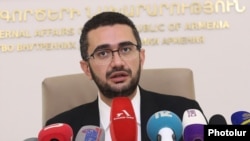
Ghazarian cited a sharp rise in citizenship applications received in the last few years.
“Their number exceeded 32,000 in 2025, which is a record high in Armenia's history,” he said, adding that most of the applicants are ethnic Armenians from Russia.
Ghazarian suggested that they want to bypass serious travel restrictions imposed by Western nations on Russian citizens following Russia’s 2022 invasion of Ukraine. For them, Armenian citizenship is first and foremost a travel document, he said.
“This, in my expert opinion, is a problem, and this problem must be addressed … We will soon present a draft of relevant legislative amendments that would address this problem,” the official told a news conference.
Under Armenian law, foreigners can become Armenia’s citizens if they live in the country for at least three years, speak its official language and are familiar with its constitution. Diaspora Armenians are exempt from these requirements.
Armenia’s National Security Service (NSS) already proposed in July 2022 that they should be eligible for fast-track dual citizenship only if they have stayed in the country for at least 60 days over the past two years. The NSS said his would minimize applications from individuals who want Armenian passports in order to more easily migrate to other parts of the world and/or simply “have nothing to do with Armenianness.”
The security service singled out ethnic Armenians from Lebanon, Syria and other Middle Eastern countries subject to serious U.S. and European Union visa restrictions. A relevant bill drafted by it never the reached the Armenian parliament.
According to Ghazarian, the annual number of citizenship applications averaged between 7,000 and 8,000 before the war in Ukraine. It surpassed 20,000 in 2023.
Nelly Davtian, the head of Armenia’s Migration and Citizenship Service, 14,770 individuals received Armenian passports in the first half of this year. Most of them are refugees from Nagorno-Karabakh, she told reporters.