




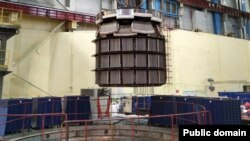
“Today, their main source of energy is the nuclear power plant,” Aliyev told Azerbaijani state television during a visit to the Nakhichevan exclave. “If that source is shut down, Armenia could face a serious energy crisis.”
In his words, Azerbaijani power supplies would be carried from a U.S.-run transit corridor which is due to connect Nakhichevan to the rest of Azerbaijan through Armenia.
The planned Trump Route for International Peace and Prosperity (TRIPP) would run along Armenia’s 43-kilometer-long border with Iran. A U.S.-Armenian agreement signed in early June calls for the creation of a joint venture that will build and manage for at least 49 years a railway, a road, energy supply lines and other infrastructure there.
The Metsamor plant’s sole functioning reactor, which generates roughly one-third of Armenia’s electricity, is due to be decommissioned in 2036. Azerbaijan as well as Turkey have long demanded its quick closure. Armenia’s former governments saw ulterior motives behind those demands, saying that the two Turkic allies simply want to weaken the South Caucasus country.
The current government has pledged to replace the Soviet-era plant with a modern facility equipped with small modular reactors (SMRs). It claims to be negotiating with various foreign countries and companies interested in the ambitious project. But it has still not reported significant progress in those talks described by some of Prime Minister Nikol Pashinian’s critics as a smokescreen for his plans to end Armenia’s reliance on nuclear energy.
Aliyev again referred to the TRIPP as an extraterritorial “Zangezur corridor” that has been sought by Baku since the 2020 war in Nagorno-Karabakh. Armenian opposition leaders have cited such statements to dismiss Pashinian’s assurances that the transit arrangement will not undermine Armenian control over the vital border with Iran. Tehran likewise remains opposed to the TRIPP.
Aliyev claimed that Baku is also involved in the planned construction of the power transmission line through the TRIPP.
“As a result of a study conducted by our specialists in the territory of Armenia, the places where power transmission line poles should be installed have even been determined,” he said.
The Armenian government has not reported such studies.