




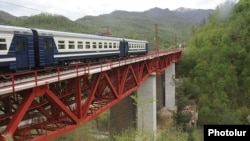
The Russian Railways (RZhD) monopoly controls the network in accordance with a 30-year management contract signed in 2008. Pashinian said in February that it should be run by another, non-Russian company because its current status discourages Turkey and Azerbaijan from using a much larger section of Armenian territory for transit purposes in the near future. He suggested that another Turkic country, Kazakhstan, could be interested in taking over it.
The Russian Foreign Ministry dismissed Pashinian’s statement as “bizarre” and “not acceptable.” Russian Deputy Prime Minister Alexei Overchuk similarly brushed aside in April Pashinian’s declared rationale for stripping RZhD of its management rights. Overchuk also threatened far-reaching retaliatory measures against Yerevan.
“Our position regarding the railway remains the same: it is our property, and the Republic of Armenia should be able to use that railway as it sees fit,” Pashinian told reporters. “I want to be very clear on this issue, there is no alternative to this.”
“We want to resolve this issue amicably … But also de jure, the question may arise that we make decisions de jure. If there is a disagreement, then we will go to arbitration to do something, to discuss,” he warned.
Pashinian also threatened to charge RZhD as much as $2 billion annually for its control of the Armenian railway. The RZhD chairman, Oleg Belozerov, said later in the day that he is “surprised and bewildered” by the threat.
“If the Armenian side considers the possibility of terminating [the management contract] or changing its terms, we have the right to expect a return on our investments,” Belozerov told the TASS news agency.
RZhD claims to have invested about $400 million in the Armenian network since taking over it about 18 years ago.
Pashinian said in April that he is “not planning” to unilaterally scrap the contract. He seems to have toughened his stance since then amid a further deterioration of Russian-Armenian relations.
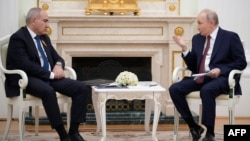
Moscow banned imports of Armenian agricultural products in late May and early June as it pressed Pashinian’s government to quickly choose between remaining part of a Russian-led economic bloc and continuing to seek membership of the European Union. Russian President Vladimir Putin insisted that Yerevan hold a referendum on the issue “as soon as possible” when he spoke with Pashinian by phone on Monday.
Pashinian said on Thursday that his administration is being punished by Moscow for seeking an “alternative” to Armenia’s alliance with Russia. Holding the referendum now, he said, would be premature because “that alternative has not yet been formed.”
Pashinian’s government enacted last year a law declaring the “start of a process of Armenia's accession to the European Union.” Its domestic critics denounced the move as reckless, saying that the EU will not admit the South Caucasus country in the foreseeable future. No EU member state or institution has voiced explicit support for such a prospect so far.
Pashinian also repeated his claims that the Russian trade restrictions imposed on Armenia mean the Eurasian Economic Union (EEU) is “paralyzed.” He said he will raise the matter with the prime ministers of Russia and other EEU member states during a meeting scheduled for August 6-7.
“And if this issue is not resolved quickly, I am 100 percent sure that Armenia will overcome this problem while the EEU will not,” he said without elaborating.
Pashinian insisted on Wednesday that he still has no plans to pull his country of the Russian-led trade bloc that gives Armenian exporters tariff-free access to Russia, their main market. Armenian farmers and agribusiness firms are particularly dependent on the Russian market. Armenia’s overall exports fell by over 20 percent in June, according to government data.
Russia’s Foreign Intelligence Service (SVR) claimed on Tuesday that Armenia’s exit from the EEU would plunge the country into a “deep economic crisis” and destabilize its government. Moscow threatened earlier to take other punitive measures against Yerevan such as a sharp rise in the price of Russian natural gas supplied to Armenia, curbs on Russian tourists visiting the country and tougher requirements for hundreds of thousands of Armenian migrant workers in Russia.