


Speaking to Prime Minister Nikol Pashinian on Monday, Russian President Vladimir Putin insisted that Armenia hold “as soon as possible” a referendum on leaving a Russian-led trade bloc and joining the European Union. For his part, Pashinian complained about Russian bans on imports of Armenian agricultural products imposed in late May and early June. Neither side reported any understandings reached by them.
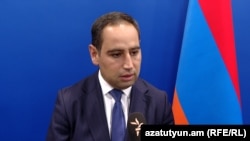
“These are issues that will be discussed, and I am hopeful that these issues will be resolved,” Minister of Territorial Administration and Infrastructures Davit Khudatian told RFE/RL’s Armenian Service.
“I am confident that a significant part of the issues will be resolved and settled in the near future because if we take into account the pre-election period [in Armenia,] we must say that some colleagues, mainly from the opposition, were talking about much more pessimistic scenarios, including the collapse of the Armenian economy and the severance of all possible relations with Russia,” he said. “But today we see that the situation is different.”
Khudatian, who is a senior member of Pashinian’s Civil Contract party, did not specify just how Yerevan could overcome the strong Russian objections to its pro-Western foreign policy.
Pashinian and his political allies already assured voters in the run-up to Armenia’s June 7 parliamentary elections that the Russians will lift the sanctions in case of Civil Contract’s election victory. The premier also declared that he is planning to visit Moscow later in June.
Putin has not only not received Pashinian but also declined to congratulate him on his election victory. Russian officials have added their voice to Armenian opposition claims that the vote was marred by serious fraud. Nor has Moscow lifted any of its trade restrictions.
Artur Khachatrian, an Armenian opposition lawmaker, emphasized these facts, saying they show that “there is no progress” in Russian-Armenian relations. Echoing statements by Russian officials, Khachatrian scoffed at Pashinian’s efforts to seek EU membership while continuing to take economic advantage of Russia.
“It’s like a man who comes home and says to his wife, ‘You know, I want to move in with my female neighbor, but since she hasn't said yes to me, would you mind continuing to feed me and let me live with you?’” he told RFE/RL’s Armenian Service.