




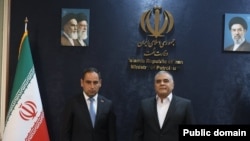
Khudatian met with Iran’s Vice President Hamid Pourmohammadi, Oil Minister Mohsen Paknejad and Energy Minister Abbas Aliabadi during the visit.
According to the Armenian Ministry of Territorial Administration and Infrastructures, he and Paknejad spoke about “increasing the volume of gas supplied as well as expanding trade in the energy sector.” Paknejad reportedly expressed Tehran’s readiness to supply more gas to Armenia.
“Armenia has helped Iran during difficult days, and we also seek to help this friendly country,” the official IRNA news agency quoted him as telling journalists after the talks.
The two sides agreed to set up a “joint specialized task force” that will look into practical modalities of expanding Armenian-Iranian energy ties. Khudatian was reported to tell Pourmohammadi that this is of “strategic importance” to Yerevan.
Russia accounts for more than 80 percent of some 2.3 billion cubic meters of natural gas imported by Armenia each year. The rest of those supplies come from Iran through a pipeline with an estimated annual capacity of up to 2 billion cubic meters.
The Russian gas price for the South Caucasus country is set well below international market-based levels. President Vladimir Putin and other Russian leaders warned of an end to that discount in May as Moscow stepped up economic pressure on Yerevan over its pro-Western foreign policy.
“We supply gas to Armenia at a quarter of its price, to our own detriment (the price in Armenia is $177.50 per thousand cubic meters, while in Europe it's $633 per thousand cubic meters) … What we get in return is [Prime Minister Nikol] Pashinian's meanness and dishonesty. This cannot continue,” said Vyacheslav Volodin, the State Duma speaker.
Pashinian dismissed the Russian threats at the time. He claimed that Armenia sill soon be awash with “billions and trillions” of dollars as a result of transport links and other commercial ties forged with neighboring Turkey and Azerbaijan. The country can therefore afford a higher gas price, he said.
In addition to being supplied to households and power plants, Russian gas is also heavily used in some sectors of the Armenian economy such as greenhouse farming. Iranian gas is believed to be significantly more expensive even if Yerevan pays for it with electricity exported to the Islamic Republic.
The Armenian government has repeatedly announced plans to boost gas imports from Iran in the last few years. But there appears to have been no sizable increase in their volume to date.