


According to an official German readout of the call, Merz and Pashinian discussed “the current situation in the Middle East, Russia's war against Ukraine, and its impact on the South Caucasus.”
“The Chancellor encouraged further steps in the peace process between Armenia and Azerbaijan and emphasized its importance for regional stability,” it said without elaborating.
Pashinian’s office reported, for its part, that the two men spoke about “peace established between Armenia and Azerbaijan” and agreed on its importance for “stable and lasting peace in the region.” It also gave no details.
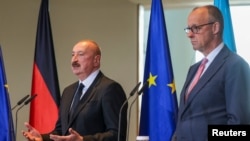
Merz hailed the “historic” Armenian-Azerbaijani peace treaty initialed last August during a joint news conference with Aliyev that followed after their talks in Berlin on Tuesday. He described it as an “opportunity to resolve a conflict that has lasted for decades.”
“Whatever we can do to contribute to this from a German and European perspective, we will do,” added the German leader.
Azerbaijan makes the signing of the peace treaty conditional on a change of Armenia’s constitution which it says lays claim to Nagorno-Karabakh recaptured by Baku in 2023. While rejecting the Azerbaijani precondition in public, Pashinian has repeatedly called for the kind of constitutional change that is demanded by Aliyev.
The Armenian government drafted a new constitution earlier this year. In parliamentary elections held last month, Pashinian’s Civil Contract party fell short of a two-thirds majority in the new National Assembly required for putting the draft on a referendum. The Armenian opposition has vowed to prevent such a vote. Pashinian has yet to clarify how he is planning to overcome this hurdle.
Baku also wants Yerevan to open a land corridor connecting Azerbaijan to its Nakhichevan exclave and Turkey. Pashinian’s government has agreed to let the United States open and manage such a corridor that would run along Armenia’s border with Iran. Tehran remains opposed to the transit arrangement.
“The South Caucasus is also gaining importance as a link between Europe and Asia,” Merz said on Tuesday. “New transport and trade corridors are creating economic potential that we want to unlock together.”