





They dismissed the Armenian government’s calls to redirect their exports to the European Union, saying that they cannot find a realistic alternative to the Russian market in the immediate future and need other forms of support to avoid closure. In particular, they said, the government should subsidize their domestic sales, ease regulations and freeze their loan repayments to banks.
Citing sanitary grounds, Russian authorities blocked multimillion-dollar imports of Armenian fruits, vegetables, mineral water, flowers, fish and some alcoholic beverages in late May and early June amid Moscow’s growing warnings about the economic cost of Yerevan’s deepening ties with the EU.
The EU responded to the sanctions by providing 52 million euros ($60 million) in urgent financial aid to the Armenian government and promising to open its market to these and other Armenian products. For its part, the government offered subsidies to local farmers and agribusiness firms finding new markets abroad. Last week, it also approved new licensing rules aimed at facilitating Armenian fish exports to EU member states.
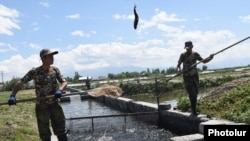
“It’s now possible to export fish and related products from Armenia to the European Union,” Economy Minister Gevorg Papoyan declared in a video message posted on Facebook on Monday. “It wasn’t possible before. All necessary permits have been received from the EU, and all procedures have been adopted in Armenia.”
Papoyan’s statement clearly did not convince the fish farmers that rallied outside the main government building in Yerevan the following morning. They said that they cannot quickly switch to the EU market due to a lack of established business contacts, logistical problems and the bloc’s stringent food safety standards.
“European fish producers were our competitors before the [Western] sanctions against Russia,” Hayk Hovannisian, who owns a fish farm in a village in the southern Ararat province, told RFE/RL’s Armenian Service. “We could not compete with them. If we had trouble competing with them in Russia, how can we compete with them in Europe?”
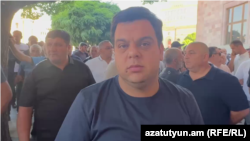
“Over the past ten years, we have gone through various force majeure situations: weather conditions, exchange rate fluctuations, wars,” said Rafael Poghosian, the owner of a larger fish farm located in the same community. “Fish farmers have overcome all of this on their own, without asking anything from the state. But now we can’t get by anymore.”
“Do you know how much we lose every day? If things continue like this, we all may collapse,” another protester, Artyom Torosian, told reporters.
The protesters demanded a meeting with Deputy Prime Minister Mher Grigorian, rather than Papoyan. Grigorian cautioned last week that the Armenian Economy Ministry should take more measures to redirect food exports to the EU. In a statement issued during the protest, the ministry said it will organize on Wednesday an “online awareness event” for fish farmers interested in selling their products in Europe.
Fish farming in Armenia has grown dramatically in the last 10-15 years on the back of soaring fish exports almost fully absorbed by Russia. The latter reportedly imported about $80 million worth of Armenian fish last year, sharply up from $3.6 million in 2016.