




The ministry drew this conclusion in a written opinion submitted to the Armenian government. But citing political reasons, it recommended the agreement’s approval by the government, which was formalized on Thursday.
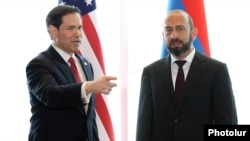
The deal was signed by U.S. Secretary of State Marco Rubio and Armenian Foreign Minister Ararat Mirzoyan in early June. It lays out the key terms of the planned the Trump Route for International Peace and Prosperity (TRIPP) that would run along Armenia’s border with Iran and connect Azerbaijan to its Nakhichevan exclave and Turkey.
It calls for the creation of a joint venture that will manage for at least 49 years a railway, a road, energy supply lines and other infrastructure to be built along the corridor. The U.S. government will own 74 percent of the TRIPP Development Company (TDC) that will receive “exclusive land use rights, development rights, related permissions, and all other rights” necessary for the transit arrangement.
While upholding Armenia’s “full sovereignty and jurisdiction over its borders and customs operations,” the agreement commits the Armenian government to the so-called “front office/back office” model whereby private operators hired by the TDC will provide “customer-facing services” at the border crossings with Azerbaijan. Armenian officials are to be given be a “back office” role there.
“It should be noted that according to [Armenia’s] Law on the State Border, the processing of persons, vehicles, cargo and other property across the border of Armenia is carried out by its border guards and customs authorities,” the Justice Ministry said in this regard. “Therefore, the authority to check relevant documents and allow passage through the state border is reserved exclusively for state bodies.”
The ministry also found that tax exemptions that will be granted to the TDC and its subsidiaries contradict Armenian tax legislation. Contacted by RFE/RL’s Armenian Service, it declined to say whether it will draft or recommend legal amendments that will bring the U.S.-Armenian agreement into conformity with Armenian law.
The deal says that it shall take precedence “in case of any conflict with Armenian law.” It has to be validated by the country’s Constitutional Court before being ratified by the Armenian parliament.
Azerbaijan’s President Ilham Aliyev has said that Azerbaijanis travelling to and from Nakhichevan “should not see the faces of Armenian border guards.” Prime Minister Nikol Pashinian has signaled readiness to meet that demand, saying that modern technology will be used to exclude physical contact between Armenian officers and Azerbaijani travelers.
Pashinian has thus given more ammunition to his domestic critics who say that the TRIPP amounts to the kind of an extraterritorial “Zangezur corridor” that is sought by Baku. Aliyev again made the same point last week.
Iran remains opposed to the TRIPP, fearing that it could lead to U.S. security presence along the Armenian-Iranian border and undermine Armenian control of it. The Iranian ambassador to Armenia indicated on July 8 that Yerevan has still not addressed Tehran’s “very legitimate and logical” concerns. Pashinian made clear the following day that he remains committed to implementing the TRIPP project “as soon as possible.”