


The EU’s decision-making European Council listed “cyber threats, foreign information manipulation and interference and illicit financial flows” among those threats.
“Specifically, the mission will provide strategic advice, technical expertise and institutional capacity building to various national institutions in Armenia to address such threats, and will support a horizontal, whole-of-government approach,” it said in a statement.
The EU first announced the deployment in April, citing a request from Prime Minister Nikol Pashinian’s government. The latter had implicitly alleged Russian “hybrid” threats to the integrity of parliamentary elections held in Armenia on June 7. Moscow denied those claims and accused the EU of trying to turn the South Caucasus country into an anti-Russian “outpost” in the region.
“A mission that will claim to fight against interference in the affairs of a sovereign state is itself an instrument of such interference,” the Russian Foreign Ministry spokeswoman, Maria Zakharova, said on April 24.
Russian-Armenian tensions have risen further since then, with Moscow pressing Yerevan to swiftly choose between continuing to seek EU membership and remaining part of a Russian-led economic bloc essential for the Armenian economy. In the run-up to the June 7 elections, Russian authorities also banned multimillion-dollar imports of Armenian agricultural products and beverages.
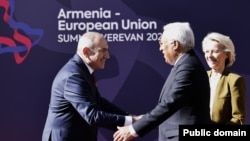
Visiting Yerevan on July 2, European Commission President Ursula von der Leyen promised that the EU will open its tightly protected and regulated market to Armenian products in addition to providing 52 million euros ($60 million) in urgent financial aid to Armenia’s government. She again denounced Moscow’s “economic coercion” after her talks with Pashinian.
EU foreign policy chief Kaja Kallas cited “Russian pressure” on Yerevan in the context of the new mission to Armenia.
“We’ll make sure Armenia does not face external coercion alone,” the European Council statement quoted her as saying.
Pashinian has made clear that he will not change his pro-EU foreign policy despite the Russian sanctions. He has also downplayed their impact on the Armenian economy.
Armenian exports to Russia reached almost $3 billion last year, compared with $667 million worth of goods exported to EU member states. Russian officials put at $700 million the annual amount of imports from Armenia affected by the trade restrictions. They have warned of other punitive measures such a surge in the price of Russian natural gas supplied to Armenia.